The Delvers of Dàrkmesa campaign rules represent the culmination of my ten years exploring the theory and spirit of tabletop roleplaying games in the vein of Dungeons & Dragons.
This project began in 2008 in the wake of D&D 4th Edition. But that inflection point needs some context.
I had been playing D&D since 2003, when a new friend gave me a copy of the 3rd Edition D&D Player's Handbook, having recently upgraded to 3.5 himself. I read every word in that handbook one thousand times over. I was running games of 3.5 for my friends soon after, and quickly settled into a nice groove: each campaign I tried to run would last three to four sessions, only to spiral out of control due to my lack of experience.
In my heart, I usually blamed the players for how things would fall apart. I had played the epic campaigns through in my head, and tried to run them all to that end. Didn't they know that Tolkien-level excitement and wonder awaited them, if they could just go along with the story? They never seemed to march to the tune, despite their best efforts. Luckily, we were young, and all still in school in our home town. Starting a new game every month was never an issue. I had a million tired fantasy tropes that I yearned to emulate at the table, and a good handful of friends more than willing to indulge me.
I never admitted that I blamed them, and that was good, because it was my fault and I didn't know it. I didn't know that the stories I liked to read and write were not the ones I liked to play in or run. I couldn't see that my campaigns as conceived were little more than setting and stage direction. It was truly the bliss (or perhaps, frustration) of ignorance.
You see, the friend that introduced me to D&D was the first person I ever met who played. That made me the second person I ever knew who played. Each of my other friends who I invited to play then became the third, fourth, fifth, and so on. We were making it up as we went. Sure, we were using the rules. But the rules don't tell you how to play. Not really. And back then, it was faster to walk to the library and check-out a Dragonlance novel than to look up anything online. How other people played was a complete mystery to all of us.
Around 2007, the older cousin of a friend of mine came to town. His name was (is) Nick, and besides being a math genius, he was also an avid player of 2nd edition D&D. Once he found out his little cousin and co were all playing D&D on the weekends, he offered to run a (3.5 converted) game of Ravenloft for seven or eight of us.
That was good D&D. I played a monk, which was a terrible class in 3.5. But the D&D was good, so I had fun.
Then we went back to playing our own games (which I ran), and they sucked again. I would often pine away in my memory for the details of that game, searching for its secret sauce.
In 2008, 4th edition D&D is released, and for the first time, the veil of design is peeled back for me. The deliberate ways that the game was laid out and organized, the brutal crackdown on the numbers, the every inch regulated and standardized.
D&D it was not. My friends all lamented the something that was lost in translation. I maintained always that I loved 4th edition, but found it rather hard to express precisely why in the language of fun. In my eyes, 4th edition was designed to a very specific end: tactical combat play. In that, it succeeded. It was designed to be learned quickly. Again, it succeeded there. It was designed to look modern and aesthetically consistent. A+ again. It was the right product, but for the wrong market.
So my theory crafting and homebrewing began. "There must be a way," I thought, "to bring the principles of design from 4th edition into 3.5 such that we can play a superior hybrid game."
It should be said: 3.5 was universally regarded as broken by 2008. How broken exactly was up for debate, but the sheer lack of direction for the design of the game and its splat books was becoming a malignant issue. There was too much game, and no central idea to measure each component's worth and validity against. One of the primary draws to a new game from the player's perspective was the chance to try out new classes and options. But from the other side of the table, every new feature was a chance to break the game.
Notebook after notebook did I fill with my Frankenstein D&D hacks. If I recall correctly, the first things I ever scribbled house rules about were skills and feats. Did we really need over 36 skills? And who knows how many hundred feats? Do those options really enrich play, or do they just tickle the fancy of min/maxers?
By 2009, my family had DSL and I had my own laptop for school. So I decided to start Googling these questions and delving for answers in the dark halls of the interweb.
What I discovered was called the Old School Renaissance. It had begun around 2006 or 2007, as best I can tell, with some bloggers connecting on various forums and posts. They shared ideas from their history with the game, which stretched back to its very beginnings, and even before. They knew the old rulesets weren't perfect, and offered their solutions to the age-old problems. There was debate and proselytism among great grognard philosophers, and countless quiet members of the community, like me, just trying to absorb it all.
These champions of the old school tore my fragile conceptions about D&D apart, like the Twelve prophets of the Hebrew Bible chastising Israel. What was this game I had been playing all these years? Where had it come from, and what great pillars of its history had been lost to its many transmutations? Had we taken the wisdom of its forefathers for granted? Nowhere else have I seen such thoughtful effort by people to justify their ideas about a hobby and its function. While everyone else spent three years learning Pathfinder, I was mesmerized by the mysteries of OSR games.
If this era (c. 2006-2011) was indeed the Old School "Renaissance," then what happened in 2012 was the Old School "Industrial Revolution." In January, Wizards of the Coast announced that the short-lived 4th edition would soon be replaced by a new D&D, "D&D Next." In May, they began a massive open playtest of the rules they were working on.
The forums that existed on the old WotC website containing all of the playtest feedback and discussion were truly a treasure of knowledge and design theory. I was well into my obsession with writing a better ruleset by 2012, and I consider myself extremely lucky to have had the chance to explore those million musings before they were archived later that year.
For two years, there seemed to be no word of the next D&D, but my mind never stopped swirling around the problems the OSR had illuminated. As I got further into college, time for playing the game became scarce, but my interest in thinking about it only grew. The homebrews I made became smaller and simpler. There were fewer and fewer rules each time I would revise or start again. I was getting better at the design, but deep down I still didn't understand what I wanted. I was designing for better design's sake, but not for the sake of better play. Indeed, most of my homebrews never saw the light of day. The ones I did test largely felt like playing any other ruleset.
It doesn't matter much what font you write the stage directions in, turns out.
In 2014, D&D 5 came out, and my friends loved it. It was the greatest thing since sliced bread, fixing all the problems with 3.5, but still holding onto that something that 4 had abandoned.
But when I looked at it, I was disappointed. Sure, advantage/disadvantage is a great mechanic. And yeah, the monk is way better now. And oh hey, they are consciously keeping the official splat books and feats and skills and classes under control. All good things, no doubt, for those of us content with the quality of play we had achieved throughout the years. But D&D 5 didn't do what I desperately wanted it to do.
It didn't show me how to design toward something. D&D 5 is the everyman's game. It's a story game, it's a tactical combat game, it's epic high fantasy, it's gritty low fantasy. It's everything, and nothing. At the table, it feels just like 3.5 did when my friends and I couldn't yet afford the extra books.
Fast-forward another year, and Critical Role is D&D's technological revolution. D&D is sexy now, and it rivals the best TV shows for hours of content and number of dedicated fans. Like all instances of celebrity art, Critical Role is at first inspiring, and then soul crushing. Inspiring because it shows you what tabletop RPGs can deliver, and soul crushing because I am not friends with a cadre of professional voice actors who want nothing more than to practice their acting around my narrative, with some combat thrown in to spice things up. It isn't just an unattainable ideal, it may actually be an un-approachable ideal depending on the friends you have.
A cursory scan of D&D subreddits these days will show you the Critical Role heartbreak phenomenon writ large. DMs are afraid to let their players fail. They're afraid to change the plans they have for their narrative in response to what the players do. They hand their players stage directions, and instead of amazing voice actors and improv artists, it turns out their players are just regular people. The story-based D&D facade all comes crashing down when you try to fit it into the real context that the game has in our lives. A weekly hobby for a handful of non-writers and non-actors with shifting schedules and more important things to remember than the evil motivations of the Demon Vicar of Nowheresville in your tabletop soap opera guest-starring the player characters.
But even a few years into playing and DMing 5e, I still maintained that top-down DM fiat narrative was a viable play strategy. And it wasn't until a little later, when one of my close friends ran a short-lived game in which I played, that the final trigger for my OSR metamorphosis would occur.
The setup was this: the party (which had several new members) were asked to convene at an inn to receive a quest from an NPC. We did, and the NPC told us how to get to a mythic dungeon full of (literally) civilizations worth of treasure. If we do it, the NPC gets to keep whatever scrolls and spellbooks we find in the loot. My guy is a fighter, so that is fine with me.
The party leaves for the dungeon, which is in the center of a crazy necrotic swamp that has emerged around it because the dungeon is the fossilized remains of an ancient dragon god (cool) which is causing the land to transform as it decays (super cool). When we arrive, there is a crew of evil dudes camping around the dungeon entrance, which we battle and defeat in a fight (sweet). Then, upon entering the dungeon, we find out that all of the treasure has already been looted and thrown through a portal into the plane of Limbo (...what?).
Now, from my friend's perspective, he was offering the potential for a sweet adventure on a rarely-explored plane of existence. And had that been the hook for the adventure from the beginning, I would have been more than excited.
But from my perspective, my character's motivation to adventure had been flushed down the drain. That might not be so bad (hey, things don't always turn out the way your character wants), but my poor dwarf was also trapped by the swamp. I tried to make a choice about what adventure my character would pursue, and then when that was turned on its head, I was denied a second choice. Not only was the original intent of the adventure no longer an option, but if my character jumped through that portal, there was literally no way for me to control whether I could turn back. No way for me to make an actual choice.
I was outraged after the fact, and it surprised me! This was no different than a hundred other times that one of my friends or I had weaved a D&D web around our players to get them to do what we wanted. The difference this time was how obvious it was to me given the mindset that I was in. I didn't blame my friend, I blamed our collective understanding of the game.
The swamp was not an obstacle to the treasure, because the treasure wasn't there anymore. The swamp was an obstacle to beginning the adventure, or any other adventure for that matter, if the party had changed its mind. The dungeon was the single source of player-DM agreement ahead of time, and it was thrown out. The foundational structure of the game, that there was a treasure to be had if some obstacles were overcome, was abandoned for the sake of an unsure reward (the treasure was in Limbo, after all) after an indeterminate amount of time and obstacles.
The contract of the game was broken, I was mad, and that was the answer I had always been looking for. What was the contract that my games should make between the DM and the players? Whatever that contract, design the game toward it.
D&D 5 makes no contracts. All forms of play are equally valid, and therefore there can be no measure of what games succeed or fail except on the scale of fun. This makes DMing, and DM prep especially, a nightmare of guesswork no matter how many books or tips or tools you have. What type of game will be fulfilling? What type of game will last? How do I get the players to ask about my availability to play rather than trying to chase them?
Well what if, given the wealth of OSR knowledge that I had absorbed, I made the contract of my campaign specific in the way that is time tested:
In this campaign, the player characters will explore a megadungeon for treasure. They will frequently return to the outlying town or towns to restock and rest, and may occasionally pursue non-dungeon adventures when the desire strikes them. New players and characters can come in or be swapped in at any point while the party is in town. No individual player needs to attend every session because no individual character needs to be on any given delve.
I, the DM, promise to prepare for that. The players promise to bring characters that will eagerly pursue that cadence of play. It doesn't create any unspoken requirements to attend every session for the sake of keeping in the loop of the plot. It doesn't mislead players as to what they will be doing. And most importantly, it takes a hard line on the boundaries of the play area, but within that play area, there is real choice with real consequence. No Quantum Ogre, no DM fiat.
And so, if I designed a ruleset around that contract, and DMed the game around that contract, I would be able to actually improve the game from session to session because I and the players would be pursuing the same goal. Which finally brings me to Delvers of Dàrkmesa.
Once I landed on the idea of the megadungeon as a distillation of the time-tested campaign promise, I thought about making my own take on Dwimmermount (if only for the supremely euphonic nature of the name), but decided instead to go completely homebrew. That's how Dàrkmesa came to be. I was struck by the double meaning of mesa (a huge rock formation that could easily fit a megadungeon inside, as well as the Spanish/Latin root for table), and what would a dungeon be without darkness? The Delvers part is just to drive the point home. Both in the sense that the characters will be primarily engaged in exploring a dungeon, and in the sense that the game is about them and about their exploration, not some arbitrary story I have concocted.
The rules and classes and example spells to include all fell into place now that I had a gameplay goal in mind other than "have fun." Many of the strangest parts of old school games that I could never understand before started to make sense and became incredibly attractive aspects of the experience for me.
Of course the game should be deadly, because that is a large part of what creates drama in a campaign with no forced plot. Of course random encounters were necessary, to keep the players and the DM honest as they all pursued the campaign goal: random chance is what keeps a non-narrative game alive. Of course two hundred pig-faced orcs appearing in a dungeon cavern is a good encounter, because it forces the players to bring to the table what makes them good players, not well-statted characters. And finally, of course the dungeon is the primordial soup from which all good games emerge, because it is the most apt compromise between what the DM needs to do, and what the players need to do. It creates strict boundaries that allow the DM to prepare more of the right thing, but when done right it forces no specific action on the players other than to engage. They want the treasure, and however they get it is by definition a fine way to play. That's why we all play this game, to get the treasure that exists hidden in the forgotten halls of our collective imagination and good company. So why hide the ball? Why not be clear about how agency works in the game right from the beginning? Why not embrace the canvas that was originally conceived for the game, and was so important that it became the first word in its name?
Luckily, it only took me ten years of searching to figure that out. Now I have the rest of my time to play.

Pen & Paper RPG design. A little old school, a little unorthodox.
Showing posts with label math. Show all posts
Showing posts with label math. Show all posts
Sunday, February 17, 2019

Monday, October 19, 2015
The Difficulty of Tasks and Leveling Up
I've posted before about a different way of handling leveling up, so that there isn't so much number crunching to be done. I've come across a new one since then which involves slightly more math, but is quite slim and efficient.
The idea comes from Basic Fantasy RPG's optional rules section. It uses a simple table for ability check DC's that applies over all levels. The specific math doesn't matter for the sake of discussion, but if you want to know, it looks like this:
The idea comes from Basic Fantasy RPG's optional rules section. It uses a simple table for ability check DC's that applies over all levels. The specific math doesn't matter for the sake of discussion, but if you want to know, it looks like this:
Character Level Ability Check DC
1 17
2-3 16
4-5 15
6-7 14
... ...
20 7
The assumption here is that a DC's static value doesn't change with the task being attempted, but rather with character level. Characters will get better at doing things as they level up. Much better in the long run, but that covers all twenty levels, so it isn't very dramatic from one level to the next. BFRPG only suggests it for ability checks. I would add skill checks to this as well, just to make things as cohesive and simple as possible.
So, climbing that sheer cliff becomes easier and easier as you level up. And the same goes for smithing that cool sword, or tracking those goblins through the woods.
I've come to love the advantage/disadvantage rule from D&D 5th as a way of quickly and easily adjudicating whether something is easier or harder than usual. That combined with this DC list is actually a very nice way of determining the target number for anything outside of combat.
I guess what I'm getting at in this post and that other post from a while ago is that if you have numbers simultaneously going up on BOTH sides of the equation, then you are doing yourself and your system a disservice.
Think about it: A level 1 rogue in D&D 3.5 has roughly a +5 to lock-picking, and comes across DC 20 locks in all his dungeon exploits. That's a target number of 15 on the d20, or 30% chance of success. Then that rogue levels up and up and up and gets to level 10. Since he's been putting ranks in lock-picking a bunch, his bonus to that is now +15. But all the locks he comes across are now DC 30. So what is the target number on the d20? Still 15! That means this rogue still only has a 30% chance of picking the locks he comes across.
In fact, this was even more egregious in the DMG for 3.5 and 4th edition D&D, where the authors gave you a table for appropriate DCs for things as the characters leveled up, which got harder instead of easier for the same tasks and checks. So climbing a rock wall for level 1 characters was a DC 15 climb check, and THE SAME ROCK WALL for level 20 characters was a DC 25 climb check.
I'd go so far as to say that this encourages bad DMing habits. After all, if locks keep getting harder and harder to pick, then simple locked doors are as appropriate a challenge for level 10 characters as they are for level 1 characters, right?
WRONG! If your level 10 characters are still sneaking up to doors in dungeons and banking on a good roll to pick a lock without alerting wandering monsters, then you haven't delved into the true potential that is high level RPG play.
That level 10 rogue should be able to pick that lock no problem (or at least with much LESS problem than his level 1 self). But that shouldn't be all he has to do. This time around, there is an encounter going on in the room that the rest of the party is trying to shield him from, and the walls are slowly closing in so time is an issue, and there's contact poison on the doorknob so a failed check results in paralysis.
THAT'S the difference between the locked doors in front of a level 1 rogue and a level 10 rogue.
Wednesday, March 11, 2015
RPG Tools of the Trade: Weapons
The bastard sword is everything that is wrong with the Dungeons & Dragons style of weapon mechanics.
The bastard sword was put into the game because they needed a sword between the longsword (d8) and the greatsword (2d6 or 1d12, depending on the edition).
But then they also needed a style of sword between one-handed and two-handed...
Well they put in a bunch of rules and regulations and exotic weapon proficiencies, but as it ends up, the bastard sword was always the best bang for your buck. If you were a fighter and you weren't wielding a bastard sword and heavy shield, you were a fool.
I'm gonna get a little technical here, but bear with me. These kinds of breaks within a game rule module (i.e., the weapons system) results from a failure to define the system's "space." See, the vast majority of weapons in D&D, until the bastard sword, were either one-handed, or two-handed, never both. Somewhere along the line, someone decided to give a mediocre bonus for wielding a one-handed weapon such as a longsword in two hands (strength bonus plus a half, for instance, or the flat +1 damage in 4e, etc.). But even that addition was okay, because it didn't muddle the two categories in form or function.
Then the bastard sword was born out of the two-category wedlock (pun intended) and everything went down hill.
So here are the dimensions of your "weapons space" that you have to define when you are designing your game's weapon system:
-First: The damage dimension.
D&D did this worse than just about anyone. 1, 1d3, 1d4, 1d6, 1d8, 2d4, 1d10, 1d12, 2d6, 3d4, 2d8....it's garbage. There is no need for this. Not to mention that a dagger (d4) is just as deadly as a greatsword (2d6) when used by the right person in real life and in fantasy literature and film, so why screw them in your system?
No, you need to figure out 2-4 serious damage categories for your weapons and not break them. I use 1d6 (one-handed) and 2d6 drop the lower die (two-handed). This makes every weapon equally deadly on a good hit, but still gives larger weapons higher average damage. You could also do something like 1d6 small melee, 1d10 large melee, 1d4 small ranged, 1d8 large ranged. This balances the range-damage dichotomy pretty well, and gives you something to show for that extra hand you need for large weapons.
-Second: The proficiency dimension.
I like to give my players bonuses. If you are giving someone a penalty that isn't in-game and situational, you need to take a long, hard look in the mirror and ask yourself if you need help.
Why would I play a game that takes time to tell me all the things my character is bad at? No. that -4 "non-proficiency" penalty from 3.5? That shit needs to GO. And those countless proficiency bonuses from 4e? God, I don't know what's worse, number inflation, or random number redistribution to make things look more balanced when they are mathematically the same as before.
Here's what I do: each weapon has basic properties, trained properties, and mastery properties. If you have no proficiency with the weapon, you get the basic package when using it, and that's it. No penalties, no financing charges, no early cancellation fees. You just get vanilla, and that is always better than nothing.
You trained in that weapon though? Well, now you start getting some extra cool stuff on top of the basic package, like the ability to counter attack with a rapier when your enemy misses you badly, or the ability to circumvent shields when you swing your flail, or a sweet little bonus to AC for knowing how to use that bo-staff right.
Mastery works the same way, you get even more cool stuff, like the ability to do grapple maneuvers with your greatsword (like you're supposed to when you're good with one), or more devastating critical hits with your battle ax, or the ability to throw that greatclub....okay, well, maybe not that last one, but you get the drift.
Third: The accessibility dimension.
Lastly, you have to figure out what groups you are gonna package these pointy suckers into so you can easily point certain classes to their early weapon choices. For me, Simple, Light, and Heavy do the trick. If you can picture the class walking around with a greatsword, they get all three groups. More subtle, but still martially focused? Simple and light only. Wizard types that usually eschew martial combat? Simple only. Done.
Now, another important feature is character fluidity. I don't want to prevent my rogues from wielding greatswords if they want to, so there's no sense in putting up barriers to that kind of stuff. In fact, a simple rule for how to gain training or mastery in a weapon (note: simple rule, not simple in-game task) is highly recommended.
Dungeon World grants XP through misses in combat. That's not a bad idea for gaining weapon training. Think about it.
Until next time-
The bastard sword was put into the game because they needed a sword between the longsword (d8) and the greatsword (2d6 or 1d12, depending on the edition).
But then they also needed a style of sword between one-handed and two-handed...
Well they put in a bunch of rules and regulations and exotic weapon proficiencies, but as it ends up, the bastard sword was always the best bang for your buck. If you were a fighter and you weren't wielding a bastard sword and heavy shield, you were a fool.
I'm gonna get a little technical here, but bear with me. These kinds of breaks within a game rule module (i.e., the weapons system) results from a failure to define the system's "space." See, the vast majority of weapons in D&D, until the bastard sword, were either one-handed, or two-handed, never both. Somewhere along the line, someone decided to give a mediocre bonus for wielding a one-handed weapon such as a longsword in two hands (strength bonus plus a half, for instance, or the flat +1 damage in 4e, etc.). But even that addition was okay, because it didn't muddle the two categories in form or function.
Then the bastard sword was born out of the two-category wedlock (pun intended) and everything went down hill.
So here are the dimensions of your "weapons space" that you have to define when you are designing your game's weapon system:
-First: The damage dimension.
D&D did this worse than just about anyone. 1, 1d3, 1d4, 1d6, 1d8, 2d4, 1d10, 1d12, 2d6, 3d4, 2d8....it's garbage. There is no need for this. Not to mention that a dagger (d4) is just as deadly as a greatsword (2d6) when used by the right person in real life and in fantasy literature and film, so why screw them in your system?
No, you need to figure out 2-4 serious damage categories for your weapons and not break them. I use 1d6 (one-handed) and 2d6 drop the lower die (two-handed). This makes every weapon equally deadly on a good hit, but still gives larger weapons higher average damage. You could also do something like 1d6 small melee, 1d10 large melee, 1d4 small ranged, 1d8 large ranged. This balances the range-damage dichotomy pretty well, and gives you something to show for that extra hand you need for large weapons.
-Second: The proficiency dimension.
I like to give my players bonuses. If you are giving someone a penalty that isn't in-game and situational, you need to take a long, hard look in the mirror and ask yourself if you need help.
Why would I play a game that takes time to tell me all the things my character is bad at? No. that -4 "non-proficiency" penalty from 3.5? That shit needs to GO. And those countless proficiency bonuses from 4e? God, I don't know what's worse, number inflation, or random number redistribution to make things look more balanced when they are mathematically the same as before.
Here's what I do: each weapon has basic properties, trained properties, and mastery properties. If you have no proficiency with the weapon, you get the basic package when using it, and that's it. No penalties, no financing charges, no early cancellation fees. You just get vanilla, and that is always better than nothing.
You trained in that weapon though? Well, now you start getting some extra cool stuff on top of the basic package, like the ability to counter attack with a rapier when your enemy misses you badly, or the ability to circumvent shields when you swing your flail, or a sweet little bonus to AC for knowing how to use that bo-staff right.
Mastery works the same way, you get even more cool stuff, like the ability to do grapple maneuvers with your greatsword (like you're supposed to when you're good with one), or more devastating critical hits with your battle ax, or the ability to throw that greatclub....okay, well, maybe not that last one, but you get the drift.
Third: The accessibility dimension.
Lastly, you have to figure out what groups you are gonna package these pointy suckers into so you can easily point certain classes to their early weapon choices. For me, Simple, Light, and Heavy do the trick. If you can picture the class walking around with a greatsword, they get all three groups. More subtle, but still martially focused? Simple and light only. Wizard types that usually eschew martial combat? Simple only. Done.
Now, another important feature is character fluidity. I don't want to prevent my rogues from wielding greatswords if they want to, so there's no sense in putting up barriers to that kind of stuff. In fact, a simple rule for how to gain training or mastery in a weapon (note: simple rule, not simple in-game task) is highly recommended.
Dungeon World grants XP through misses in combat. That's not a bad idea for gaining weapon training. Think about it.
Until next time-
Saturday, February 7, 2015
Relative Level Instead of Objective Level
I have been drowning myself in design theory of late, and I think I came across a diamond in the rough. I guess you will have to be the judge of that.
Fact: Many many P&P RPG players enjoy character advancement. "Leveling up," if you will. Being better at challenges previously encountered, after enough training/time/exposure/experience points. They want to feel the progression. It allows them to speak confidently about what their character can do when roleplaying.
Fact: Leveling up is the #1 cause of very annoying number inflation in P&P RPGs. Dragons need high attack bonuses and armor class rating because they are fighting high level PCs, whereas goblins can have nice, small, understandable numbers because they fight low level PCs who also have nice, small, understandable stats and bonuses. If this were not the case, fighting a goblin and fighting a dragon would be equally challenging. That doesn't make sense.
(Potentially new and valuable) Fact: The objective stats of the dragons and goblins don't matter. What matters is only the relative stats of the goblins and the PCs, or the dragons and the PCs. Is the dragon a higher level than the PCs? Are the goblins a higher level than the PCs? Lower?
How to apply the fact:
So when the level 1 PCs first meet the goblins, who are also level 1, there isn't any extra math to do.
Fact: Many many P&P RPG players enjoy character advancement. "Leveling up," if you will. Being better at challenges previously encountered, after enough training/time/exposure/experience points. They want to feel the progression. It allows them to speak confidently about what their character can do when roleplaying.
Fact: Leveling up is the #1 cause of very annoying number inflation in P&P RPGs. Dragons need high attack bonuses and armor class rating because they are fighting high level PCs, whereas goblins can have nice, small, understandable numbers because they fight low level PCs who also have nice, small, understandable stats and bonuses. If this were not the case, fighting a goblin and fighting a dragon would be equally challenging. That doesn't make sense.
(Potentially new and valuable) Fact: The objective stats of the dragons and goblins don't matter. What matters is only the relative stats of the goblins and the PCs, or the dragons and the PCs. Is the dragon a higher level than the PCs? Are the goblins a higher level than the PCs? Lower?
How to apply the fact:
- Player characters record their level simply as a number from 1 to (whatever you want as a cap). Leveling up can work however you want it to.
- When the PCs get in a fight with a monster, the higher level combatant(s) get a bonus to their rolls, and the lower level combatant(s) get a penalty to their rolls. This can be a static and constant +/- 1, or it could scale with the difference in level. Your choice.
- Equal levels across the board means no adjustments.
- You don't have to adjust most other stats for level. Ever.
So when the level 1 PCs first meet the goblins, who are also level 1, there isn't any extra math to do.
Then, after the goblins, the level 1 PCs run into an owlbear, level 3. Uh oh, the owlbear gets a +1 to its attack rolls, saves, etc. etc. AND, the PCs get -1 to attack rolls, saves, etc. etc. It proves too hard and the PCs flee successfully.
A few sessions later, the same group of PCs, now level 4, go find this owlbear to get revenge. Well, now the PCs benefit from a +1 to rolls, and the owlbear suffers the -1.
That net change of +/- 2 could mean the difference between expecting success and being doomed to defeat, depending on your system's math. If it doesn't, make the swing big enough to cause the difference...or make the math of your system more bounded.
So player characters do get better, but not because of a big number on their sheet. They get better because they keep adding more and more monsters to the category that grants them bonuses while fighting.
Thoughts?
Monday, February 2, 2015
I LOVE LOW HIT POINTS
My ideal way to do HP is the old school way. Start with a good amount (two or three direct goblin attacks worth), then gain a d6 each level, but only up until a point. After that, it is a constant, small bonus for each level thereafter. It creates a diminishing returns effect (see Goblin Punch's System page for more on that), which looks a little like this:
That way the players feel like they are going somewhere early on, but they don't go so far that early threats become completely non-threatening. Also, this prevents later threats (i.e. monsters) from needing stats in the low quintillions to be a challenge for high level PCs.
Some people think you need a morale/energy/wind/fatigue AND guts/wounds/blood/constitution system to distinguish a character's actual wounds from mere shake-off-able battle wear.
Nope.
Low HP totals plus mild healing mechanics do that for you. You have 25 HP? You lose 15 HP in a fight? That's blood and guts, er, fatigue and wounds, er, whatever. You regain 4 HP after the fight with some small once-a-day self heal? Well, that 4 HP was the shake-off-able battle wear. No need to distinguish it when it happens.
But then the Paladin uses Lay on Hands? And you gained another 5 HP back? Great! That was guts. Or maybe wounds and morale, er, whatever. Doesn't matter.
The whole problem these dual-HP pool systems are trying to solve is that a barbarian with 289 HP doesn't feel half as ready to fight as one with 578 HP...because...well...he just doesn't. So they say, "Well, now the barbarian has 136 blood and 28 guts, so he's not tired, but he is pretty injured."
Personally, I think this is a terrible solution.
Our piddly human brains can't attach significance to numbers that high when it comes to bodily harm and battle fatigue. How many arrows have to be impaled in my fighter's back before he loses 100 Blood? 100 Guts? Hell if I know! How about if I had just 17 HP maximum? Well, now, probably three or four arrows would do ya (hey! just like Boromir!). Simple. Intuitive. Doesn't scare away the History majors at the table.
I don't care what your game's power-level is. I don't care if you are all playing superheroes who actively pick up entire city blocks and throw them at their enemies. The math behind a game does not, I repeat, DOES NOT have to scale with the strength of the characters and monsters if they were real.
The math of a game only ever has to scale with player understanding.
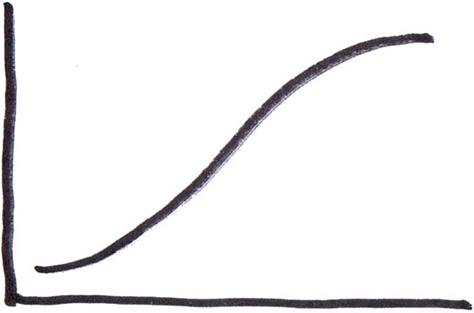 |
| (HP is the y-axis, Level is the x-axis) |
Some people think you need a morale/energy/wind/fatigue AND guts/wounds/blood/constitution system to distinguish a character's actual wounds from mere shake-off-able battle wear.
Nope.
Low HP totals plus mild healing mechanics do that for you. You have 25 HP? You lose 15 HP in a fight? That's blood and guts, er, fatigue and wounds, er, whatever. You regain 4 HP after the fight with some small once-a-day self heal? Well, that 4 HP was the shake-off-able battle wear. No need to distinguish it when it happens.
But then the Paladin uses Lay on Hands? And you gained another 5 HP back? Great! That was guts. Or maybe wounds and morale, er, whatever. Doesn't matter.
The whole problem these dual-HP pool systems are trying to solve is that a barbarian with 289 HP doesn't feel half as ready to fight as one with 578 HP...because...well...he just doesn't. So they say, "Well, now the barbarian has 136 blood and 28 guts, so he's not tired, but he is pretty injured."
Personally, I think this is a terrible solution.
Our piddly human brains can't attach significance to numbers that high when it comes to bodily harm and battle fatigue. How many arrows have to be impaled in my fighter's back before he loses 100 Blood? 100 Guts? Hell if I know! How about if I had just 17 HP maximum? Well, now, probably three or four arrows would do ya (hey! just like Boromir!). Simple. Intuitive. Doesn't scare away the History majors at the table.
I don't care what your game's power-level is. I don't care if you are all playing superheroes who actively pick up entire city blocks and throw them at their enemies. The math behind a game does not, I repeat, DOES NOT have to scale with the strength of the characters and monsters if they were real.
The math of a game only ever has to scale with player understanding.
Subscribe to:
Posts (Atom)