
Stealth checks are a mess. I have yet to meet or hear of a GM that actually uses stealth checks in any deterministic way when it involves more than a single "sneaker." Party stealth is the most common kind of stealth check made, and as far as I have experienced, the party just needs to roll a rough average above the difficulty to avoid detection. Like a skill challenge a la 4E. How else could you actually do it?
 |
| From OOTS #90 |
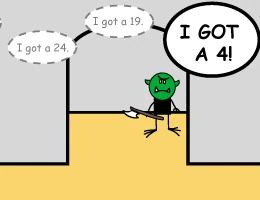
This bears mentioning, because we have all snuck up on our parent, sibling, friend, etc. in real life, and scared the ba-jeezus out of them. Sneaking up on someone who is not paying attention to their surroundings is actually pretty easy. Even cats and dogs, with their superior animal senses, can be scared out of their furry wits by a sudden jump from around the corner.
So why does the game assume you will alert your enemies to your presence most of the time, if you let the fighter or cleric anywhere in their earshot? Surprising the enemy shouldn't be so much about silence as about timing.
Take the Siege of Osgiliath, for example. Regardless of how the build-up was shot (which I feel left a lot of tension to be desired), the great thing about this scene is that the Gondorian soldiers still manage to get the jump on the orcs by hiding just inside the entrance, despite half of them having plate armor. They get a surprise round, even though the orcs know full well that there are enemies inside the walls. In fact, a lot of the stuff about this scene that bugs people actually would make for great rules-of-thumb around the table.
Yes, plate mail rings like a bag of tin cans and wind-chimes when you fight in it.
But, there is always some kind of white noise going on that will lessen the odds that someone who isn't actively listening for sounds notices a person in plate mail walking carefully.
Yes, soldiers run across the orcs' line of sight like, a dozen times just before the boats dock.
But it is dark and misty and foggy and the GM has to be honest: the orc saw a shadowy figure dart across the entrance. They know that Osgiliath is occupied, but they haven't heard any war horns. Does that really give them enough information to avoid the ambush? I don't think so.
It is a strange vestige of incorporating perception and stealth checks into the game that many GMs and players operate under two very unrealistic and paradoxical assumptions:
1) That nearly every non-living, physical detail about the world is shrouded in some kind of impenetrable fog or obscurity until such time as a good perception check is rolled.
2) That nearly everyone is fully aware of each living creature within eyesight and earshot until such time as a good stealth check is rolled against them.
Those assumptions lead to this being part of every D&D session ever:
(GM) "You guys begin trekking through the woods"
(Players) "We all go stealthily" *rollrollrollroll*
(DM) "Uh...yeah, okay you go pretty quietly on your way"
How is this even a thing? You roll one stealth check each for a whole day of travel, when earlier that day the rogue had to roll a whole stealth check just to take two steps behind an orc without it noticing? That's like saying the fighter can get through a whole day of random encounters with one attack roll, but has to roll for every attack when he encounters a pre-planned fight.
Are your characters seriously checking behind every tree and around every hill and padding every footstep to avoid contact with sentient beings? Or are you just keeping your voices low and going slow? Cuz you shouldn't need to roll for going slow, bro. Slowing down and shutting up is easy.
Are your characters trying to move fast, but not alert anyone? Tough shit. You get one or the other, unless you have some bombdotcom spell you wanna blow for super quick silent movement, or you are a high level ranger with some class feature that gives you crazy stealth stride. It is a basic fact of life, and one that needs to be preserved to have an interesting and problem-solving oriented adventure game: the faster you go, the louder you are and the more likely someone will notice you. The slower you go, the easier it is to move about without drawing attention to yourself.
Stealth is probably one of the wonkiest mechanics simply because it exists as the veil between the free-range character action outside of combat, and the turn-based character action inside of an encounter. Some might think of initiative when I say that, but initiative is "Step One" of combat, not the connecty bit. If you fail your stealth check, typically, combat begins. Maybe the target starts running away, maybe they pull out an axe and start swinging, who knows. Either way, it's now a two-player contest, and turns start being taken. If you succeed on Stealth, you remain the only "turn-taker" in the game, which means it isn't even a contest yet. No combat. Yet.
What would happen if we relaxed the combat structure of hard turns in a specific order, and instead made use of stealth merely as a means of getting the element of surprise on your side? In movies, for instance, when the action hero gets the drop on the guard guy, the hero snaps his neck or muffles him and slips a blade betwixt his ribs and that's all she wrote. In D&D, anyone but the rogue has almost no chance of taking the unsuspecting guard out in one-shot, because once combat rules kick in, damage is supposed to happen in little chunks over a long period of time. I don't see why the fighter couldn't shove his longsword through a dude's back and take him out (perhaps not dead, but certainly down), regardless of his HP. But again, if your combat is very rigidly segregated from your "non-combat" play, then it will be hard to justify anyone but the rogue being capable of shanking a dude.
And so stealth also brings up trouble with regard to how hit points work. One of the primary benefits of sneaking up on an enemy combatant is the opportunity to quickly and quietly dispose of them. However, most enemies in D&D type games have more HP than a fighter can deal in damage in one round. This winds up being "role protectionism," for the rogue. Even if the monk, or ranger, or fighter, or paladin, etc. snuck up on the enemy, they would not be able to kill them quietly, or quickly, thus giving their little stealth operation a close to 0% chance of success (where success is taking the enemy dude out without alerting the other enemies).
But enough about the problems with stealth. How do we fix it?
Well, there are a number of things:
- Stop screwing characters in heavy armor. Seriously. Give them penalties to swimming, give them a hard time when they try to run more than 50 yards, but stop forcing them to auto-fail stealth checks with your gratuitous penalties. Armor is heavy, armor is expensive, and those two things together are more than enough to counterbalance the bonus to a character's defense. In reality, D&D-type games have been biased toward not wearing much armor for a long time. If you are regularly in hand-to-hand combat, wearing no armor is suicidal. All those leather-pants-wearing thieves out there who have complained enough to be allowed into front-line fighting are messing things up for their armor-bearing allies. Reality checks should be used very sparingly when it comes to fantasy games, but this is a spot where one is sorely needed.
- There are two types of "sneak attacks." Ones where you plan to eliminate your target, and ones where you plan to get in a solid first strike against a big evil guy like a dragon. Take that into consideration when you are stating up your NPCs and monsters. If the standard ol' city guards have 5d8+12 HP each, then only the rogue can ever hope to take them out with a surprise attack. Don't do that to your players. Let your player characters outrun the rest of humanity in terms of HP and bonuses and such as they level-up. That way, a normal city guardsman always has roughly 1-8 HP, and even the bard could kill him silently with a good stab in the back. If you were hoping for the city guard to put up a good fight against your magically equipped and time-tested PCs, you are designing your encounters wrong. Simple as that.
- If a PC critically fails a stealth check, they should be seen, no question. However, a regular fail on a stealth check should be interpreted more loosely as "a complication is added to the scenario." The castle guards stop to chat, and the careful timing you did of their rounds is now totally useless. A new NPC shows up to speak to the guard, or give him some food, or something else. A third party, like a wild animal or a beggar or something, shows up and draws attention in a direction you didn't want it drawn. The dog smells you and starts to bark from his cage, but the guards are just telling it to shut-up for now. This way, when the party rolls stealth all together, there are three possible outcomes: everyone succeeds and no complications arise, some people fail and complications arise, everyone fails (or at least one critically fails) and the PCs are discovered before their plan can occur. Now, the fighter and cleric can come along just like everyone else, but each additional person is another chance for a crit-fail to show up. Bigger party = harder to go unnoticed = perfectly reasonable to me.
- Be real about how aware the enemy really is. A small camp of orcs that is feasting and wrestling are essentially unaware of their surroundings unless they have posted a lookout (which should not always be the case, unless its wartime or something). Assuming there is no lookout, the PCs should be able to sneak around their camp (in the trees) without rolling anything. If they want to foot-pad into the camp, enter tents, steal food or gold, etc., then stealth checks are needed to see how well that goes, since a stray orc could easily befall them as they reach into the chests of treasure in the middle of the camp.
- Allow the players to solve the problem without rolling. If a rock thrown in the opposite direction of the entrance can draw the lookout away from his position long enough for the party to slip inside, then the party shouldn't need to roll stealth at all so long as they figured that out and did it. An invisibility spell + slow walking should allow a character to move through an open doorway without a problem, even with a guard a few feet away. Maybe a dexterity check might be needed if someone was to almost bump into them, but you get the drift.
Those are my best pieces of advice. If you have any other tips, or you've got the ultra-genius way of resolving stealth that I could never have conceived in a million years, please leave them in the comments. Pretty please?
