Saturday, November 7, 2020

5 Things I've Learned Running COVID D&D for 10 People

 Despite my lack of posting, I still do putz around with my little D&D hack rules every once in a while. If I ever finish a complete copy I will post it here at some point. As I have iterated on my game rules over many years, I can say that the lessons learned have been worth it. Clearer answers to what makes a class a class, what behavior the rules should bother to foster, and so on are welcome insights to running any game. But that is all beside the point of this post.

Ironically, the global COVID response's prohibition on free and easy human interaction has led to the most solid D&D game run I have had in a long time, perhaps ever. We play over google hangouts, I use a very basic google spreadsheet to record initiative and status effects, and an even more basic google drawing as a place to map out larger battles. Here's a quick screenshot from the end of our second to last session:


I have little icons for all of the players, simple circles with letters for enemies, happy faces for NPCs (hostages, in this case), and other shapes for things like fog clouds (that large rectangle at the top). It has worked surprisingly well! I just need to figure out a good way to lock the background image, because I regularly move that accidentally while trying to move a character.

Honestly, I have found this much easier and quicker to manage than something like Roll20. We use a discord server to organize any links or questions or chatter, and google handles the rest easily.

BUT! Even that is a bit beside the point. What this post is about is five things I have learned from running the game (D&D 5e, by the way) in this totally remote milieu...and with TEN (yes, 10) players.

#1 - The chatter at the beginning of the session is half the fun
Back when I went to school with all of my players, we didn't really have an excuse for wasting time to chat at the beginning of our D&D sessions. But now, people have kids, people need a social outlet, and even if it weren't COVID, everyone is busy and we don't get to talk as much anymore. My games start at 7, but we don't get to the recap until at least 7:30 and that is totally fine. I fully believe that half the reason my friends show up to the game is to shoot the breeze at the start.

#2 - Having a mix of new and veteran players is the best
There is something magical about not knowing the rules of the game. This idea, or a corollary of it - namely that the more one thinks about the rules the less creative their play becomes, pervades my game design choices. For this campaign we're running straight ahead D&D 5e, so I'm not making any design choices per se. But there seems to be no better inspiration for the experienced players than watching the new players try "suboptimal" plays, and being rewarded by me according to the Rule of Cool.

#3 - A serious combat takes all session
With so many players, a combat with even just a handful of enemies will take the full three hours that we play. At first I felt bad about that, because some of the characters are more socially focused, or adventure focused, than combat focused. But there really isn't a way around it if nearly everyone is attending, which is what I want anyway. The idea I've had to address this is to make sure there are more environmental combat options (think swinging chandeliers, cover, rocks to throw, water like the map above, etc.), so that the non-fighter types have a reason to engage. Also, make sure combat is only planned for every other session at most.

#4 - Encounters are impossible to balance
I have thrown things at the party that were, on paper, supposed to be deadly, and ended up being total non-issues. On the other hand, the fight that was depicted above was very underpowered, but one of the characters nearly died because of how the players divided up their attention (and the water played a role too, so again, dynamic environments are A+). At this point, I'm doing almost no encounter math at all. With eight to nine regular players each session, they should have one "get out of jail free" card available to them if things go screwy.

#5 - The more players you have, the harder it is to ask them what they want
You might think that having a ton of players leads to decision paralysis constantly. Ten people who theoretically all have different character goals and backstory ties should just be in a constant state of disagreement about their next adventure. This is not at all what our first ten sessions have been like. Everyone seems to just want to play and not get into arguments about next steps. The occasional tough choice does warrant five or ten minutes of chatter, but the players seem to want me to railroad them a bit more than in previous campaigns I've played. One of my goals this campaign is to make lots of "hooks" in the form of places to go and people to interact with, which the characters pass by all the time. Any of them are legitimate things to explore in the world, but these detours seem to be very low on the list of things the players want to do - at least so far.

Hopefully they loosen up a bit after this first adventure arc or two. I look forward to the first time they take a breath and decide as a group what they want to do without being told by an NPC about some job.

Sunday, July 19, 2020

Delvers in Dàrkmesa - Campaign Rules 2.0

First post in over a year, and it is an updated version of the ruleset I posted as my magnum opus in February of 2019.

I can't say precisely what drives me to forever re-write these rules, though part of it is certainly a lack of play. This is a problem I hope to amend soon, if only virtually. Given that my play group has spread itself over much of the state now, that would appear to be our only viable option even without Covid-19 running amok.

Despite the dearth of play, I have, in the past year and change, had ample time to contemplate what makes a robust and flexible ruleset. I have not been posting my ideas here, mostly for lack of time or motivation, but I also find some guiding priciple in what Stephen King has said on several occassions about writing notebooks and journals, "They're a great way to immortalize bad ideas."

Now that these ideas have stewed for a while, I feel imbued with just enough confidence to put them on here.

Some of the things you may find interesting in these new rules:

  • No ability modifiers. I want treasure that provides bonuses to be the most important modifier.
  • Two "defenses" cover everything: Armor Class, and 4th Edition-style "save-on-10+" d20 rolls.
  • The most available healing has a kind of "cap" mediated by a 4th Edition-style "bloodied" status.
  • Four classes available, one per "pillar" of fantasy dungeoneering: Outlanders (wilderness travel), Sages (literacy and healing), Thieves (getting into places you aren't supposed to be), and Warriors (killin' sh*t). No race-classes so that the rules don't require changes if elves, dwarves, or halflings aren't featured in your game.
  • The rules don't include a rigid magic system. Rather, they provide examples of how to make magic self-limiting. GM discretion is paramount. Sages can be the de facto "magic user" if that is a player's aim.
  • Monsters have very simple stats, and are not meant to be "balanced" for groups of any particular level or size. Like spells and magic, example monsters are provided in a wandering monster table.
  • 1d6 weapon damage. 1 damage for unarmed strikes or hits with torches. 2d6 (or 2) for critical hits.

Sunday, February 17, 2019

Delvers of Dàrkmesa - Campaign Rules

Forward: Delvers of Dàrkmesa

The Delvers of Dàrkmesa campaign rules represent the culmination of my ten years exploring the theory and spirit of tabletop roleplaying games in the vein of Dungeons & Dragons.

This project began in 2008 in the wake of D&D 4th Edition. But that inflection point needs some context.

I had been playing D&D since 2003, when a new friend gave me a copy of the 3rd Edition D&D Player's Handbook, having recently upgraded to 3.5 himself. I read every word in that handbook one thousand times over. I was running games of 3.5 for my friends soon after, and quickly settled into a nice groove: each campaign I tried to run would last three to four sessions, only to spiral out of control due to my lack of experience.

In my heart, I usually blamed the players for how things would fall apart. I had played the epic campaigns through in my head, and tried to run them all to that end. Didn't they know that Tolkien-level excitement and wonder awaited them, if they could just go along with the story? They never seemed to march to the tune, despite their best efforts. Luckily, we were young, and all still in school in our home town. Starting a new game every month was never an issue. I had a million tired fantasy tropes that I yearned to emulate at the table, and a good handful of friends more than willing to indulge me.

I never admitted that I blamed them, and that was good, because it was my fault and I didn't know it. I didn't know that the stories I liked to read and write were not the ones I liked to play in or run. I couldn't see that my campaigns as conceived were little more than setting and stage direction. It was truly the bliss (or perhaps, frustration) of ignorance.

You see, the friend that introduced me to D&D was the first person I ever met who played. That made me the second person I ever knew who played. Each of my other friends who I invited to play then became the third, fourth, fifth, and so on. We were making it up as we went. Sure, we were using the rules. But the rules don't tell you how to play. Not really. And back then, it was faster to walk to the library and check-out a Dragonlance novel than to look up anything online. How other people played was a complete mystery to all of us.

Around 2007, the older cousin of a friend of mine came to town. His name was (is) Nick, and besides being a math genius, he was also an avid player of 2nd edition D&D. Once he found out his little cousin and co were all playing D&D on the weekends, he offered to run a (3.5 converted) game of Ravenloft for seven or eight of us.

That was good D&D. I played a monk, which was a terrible class in 3.5. But the D&D was good, so I had fun.

Then we went back to playing our own games (which I ran), and they sucked again. I would often pine away in my memory for the details of that game, searching for its secret sauce.

In 2008, 4th edition D&D is released, and for the first time, the veil of design is peeled back for me. The deliberate ways that the game was laid out and organized, the brutal crackdown on the numbers, the every inch regulated and standardized.

D&D it was not. My friends all lamented the something that was lost in translation. I maintained always that I loved 4th edition, but found it rather hard to express precisely why in the language of fun. In my eyes, 4th edition was designed to a very specific end: tactical combat play. In that, it succeeded. It was designed to be learned quickly. Again, it succeeded there. It was designed to look modern and aesthetically consistent. A+ again. It was the right product, but for the wrong market.

So my theory crafting and homebrewing began. "There must be a way," I thought, "to bring the principles of design from 4th edition into 3.5 such that we can play a superior hybrid game."

It should be said: 3.5 was universally regarded as broken by 2008. How broken exactly was up for debate, but the sheer lack of direction for the design of the game and its splat books was becoming a malignant issue. There was too much game, and no central idea to measure each component's worth and validity against. One of the primary draws to a new game from the player's perspective was the chance to try out new classes and options. But from the other side of the table, every new feature was a chance to break the game.

Notebook after notebook did I fill with my Frankenstein D&D hacks. If I recall correctly, the first things I ever scribbled house rules about were skills and feats. Did we really need over 36 skills? And who knows how many hundred feats? Do those options really enrich play, or do they just tickle the fancy of min/maxers?

By 2009, my family had DSL and I had my own laptop for school. So I decided to start Googling these questions and delving for answers in the dark halls of the interweb.

What I discovered was called the Old School Renaissance. It had begun around 2006 or 2007, as best I can tell, with some bloggers connecting on various forums and posts. They shared ideas from their history with the game, which stretched back to its very beginnings, and even before. They knew the old rulesets weren't perfect, and offered their solutions to the age-old problems. There was debate and proselytism among great grognard philosophers, and countless quiet members of the community, like me, just trying to absorb it all.

These champions of the old school tore my fragile conceptions about D&D apart, like the Twelve prophets of the Hebrew Bible chastising Israel. What was this game I had been playing all these years? Where had it come from, and what great pillars of its history had been lost to its many transmutations? Had we taken the wisdom of its forefathers for granted? Nowhere else have I seen such thoughtful effort by people to justify their ideas about a hobby and its function. While everyone else spent three years learning Pathfinder, I was mesmerized by the mysteries of OSR games.

If this era (c. 2006-2011) was indeed the Old School "Renaissance," then what happened in 2012 was the Old School "Industrial Revolution." In January, Wizards of the Coast announced that the short-lived 4th edition would soon be replaced by a new D&D, "D&D Next." In May, they began a massive open playtest of the rules they were working on.

The forums that existed on the old WotC website containing all of the playtest feedback and discussion were truly a treasure of knowledge and design theory. I was well into my obsession with writing a better ruleset by 2012, and I consider myself extremely lucky to have had the chance to explore those million musings before they were archived later that year.

For two years, there seemed to be no word of the next D&D, but my mind never stopped swirling around the problems the OSR had illuminated. As I got further into college, time for playing the game became scarce, but my interest in thinking about it only grew. The homebrews I made became smaller and simpler. There were fewer and fewer rules each time I would revise or start again. I was getting better at the design, but deep down I still didn't understand what I wanted. I was designing for better design's sake, but not for the sake of better play. Indeed, most of my homebrews never saw the light of day. The ones I did test largely felt like playing any other ruleset.

It doesn't matter much what font you write the stage directions in, turns out.

In 2014, D&D 5 came out, and my friends loved it. It was the greatest thing since sliced bread, fixing all the problems with 3.5, but still holding onto that something that 4 had abandoned.

But when I looked at it, I was disappointed. Sure, advantage/disadvantage is a great mechanic. And yeah, the monk is way better now. And oh hey, they are consciously keeping the official splat books and feats and skills and classes under control. All good things, no doubt, for those of us content with the quality of play we had achieved throughout the years. But D&D 5 didn't do what I desperately wanted it to do.

It didn't show me how to design toward something. D&D 5 is the everyman's game. It's a story game, it's a tactical combat game, it's epic high fantasy, it's gritty low fantasy. It's everything, and nothing. At the table, it feels just like 3.5 did when my friends and I couldn't yet afford the extra books.

Fast-forward another year, and Critical Role is D&D's technological revolution. D&D is sexy now, and it rivals the best TV shows for hours of content and number of dedicated fans. Like all instances of celebrity art, Critical Role is at first inspiring, and then soul crushing. Inspiring because it shows you what tabletop RPGs can deliver, and soul crushing because I am not friends with a cadre of professional voice actors who want nothing more than to practice their acting around my narrative, with some combat thrown in to spice things up. It isn't just an unattainable ideal, it may actually be an un-approachable ideal depending on the friends you have.

A cursory scan of D&D subreddits these days will show you the Critical Role heartbreak phenomenon writ large. DMs are afraid to let their players fail. They're afraid to change the plans they have for their narrative in response to what the players do. They hand their players stage directions, and instead of amazing voice actors and improv artists, it turns out their players are just regular people. The story-based D&D facade all comes crashing down when you try to fit it into the real context that the game has in our lives. A weekly hobby for a handful of non-writers and non-actors with shifting schedules and more important things to remember than the evil motivations of the Demon Vicar of Nowheresville in your tabletop soap opera guest-starring the player characters.

But even a few years into playing and DMing 5e, I still maintained that top-down DM fiat narrative was a viable play strategy. And it wasn't until a little later, when one of my close friends ran a short-lived game in which I played, that the final trigger for my OSR metamorphosis would occur.

The setup was this: the party (which had several new members) were asked to convene at an inn to receive a quest from an NPC. We did, and the NPC told us how to get to a mythic dungeon full of (literally) civilizations worth of treasure. If we do it, the NPC gets to keep whatever scrolls and spellbooks we find in the loot. My guy is a fighter, so that is fine with me.

The party leaves for the dungeon, which is in the center of a crazy necrotic swamp that has emerged around it because the dungeon is the fossilized remains of an ancient dragon god (cool) which is causing the land to transform as it decays (super cool). When we arrive, there is a crew of evil dudes camping around the dungeon entrance, which we battle and defeat in a fight (sweet). Then, upon entering the dungeon, we find out that all of the treasure has already been looted and thrown through a portal into the plane of Limbo (...what?).

Now, from my friend's perspective, he was offering the potential for a sweet adventure on a rarely-explored plane of existence. And had that been the hook for the adventure from the beginning, I would have been more than excited.

But from my perspective, my character's motivation to adventure had been flushed down the drain. That might not be so bad (hey, things don't always turn out the way your character wants), but my poor dwarf was also trapped by the swamp. I tried to make a choice about what adventure my character would pursue, and then when that was turned on its head, I was denied a second choice. Not only was the original intent of the adventure no longer an option, but if my character jumped through that portal, there was literally no way for me to control whether I could turn back. No way for me to make an actual choice.

I was outraged after the fact, and it surprised me! This was no different than a hundred other times that one of my friends or I had weaved a D&D web around our players to get them to do what we wanted. The difference this time was how obvious it was to me given the mindset that I was in. I didn't blame my friend, I blamed our collective understanding of the game.

The swamp was not an obstacle to the treasure, because the treasure wasn't there anymore. The swamp was an obstacle to beginning the adventure, or any other adventure for that matter, if the party had changed its mind. The dungeon was the single source of player-DM agreement ahead of time, and it was thrown out. The foundational structure of the game, that there was a treasure to be had if some obstacles were overcome, was abandoned for the sake of an unsure reward (the treasure was in Limbo, after all) after an indeterminate amount of time and obstacles.

The contract of the game was broken, I was mad, and that was the answer I had always been looking for. What was the contract that my games should make between the DM and the players? Whatever that contract, design the game toward it.

D&D 5 makes no contracts. All forms of play are equally valid, and therefore there can be no measure of what games succeed or fail except on the scale of fun. This makes DMing, and DM prep especially, a nightmare of guesswork no matter how many books or tips or tools you have. What type of game will be fulfilling? What type of game will last? How do I get the players to ask about my availability to play rather than trying to chase them?

Well what if, given the wealth of OSR knowledge that I had absorbed, I made the contract of my campaign specific in the way that is time tested:

In this campaign, the player characters will explore a megadungeon for treasure. They will frequently return to the outlying town or towns to restock and rest, and may occasionally pursue non-dungeon adventures when the desire strikes them. New players and characters can come in or be swapped in at any point while the party is in town. No individual player needs to attend every session because no individual character needs to be on any given delve.

I, the DM, promise to prepare for that. The players promise to bring characters that will eagerly pursue that cadence of play. It doesn't create any unspoken requirements to attend every session for the sake of keeping in the loop of the plot. It doesn't mislead players as to what they will be doing. And most importantly, it takes a hard line on the boundaries of the play area, but within that play area, there is real choice with real consequence. No Quantum Ogre, no DM fiat.

And so, if I designed a ruleset around that contract, and DMed the game around that contract, I would be able to actually improve the game from session to session because I and the players would be pursuing the same goal. Which finally brings me to Delvers of Dàrkmesa.

Once I landed on the idea of the megadungeon as a distillation of the time-tested campaign promise, I thought about making my own take on Dwimmermount (if only for the supremely euphonic nature of the name), but decided instead to go completely homebrew. That's how Dàrkmesa came to be. I was struck by the double meaning of mesa (a huge rock formation that could easily fit a megadungeon inside, as well as the Spanish/Latin root for table), and what would a dungeon be without darkness? The Delvers part is just to drive the point home. Both in the sense that the characters will be primarily engaged in exploring a dungeon, and in the sense that the game is about them and about their exploration, not some arbitrary story I have concocted.

The rules and classes and example spells to include all fell into place now that I had a gameplay goal in mind other than "have fun." Many of the strangest parts of old school games that I could never understand before started to make sense and became incredibly attractive aspects of the experience for me.

Of course the game should be deadly, because that is a large part of what creates drama in a campaign with no forced plot. Of course random encounters were necessary, to keep the players and the DM honest as they all pursued the campaign goal: random chance is what keeps a non-narrative game alive. Of course two hundred pig-faced orcs appearing in a dungeon cavern is a good encounter, because it forces the players to bring to the table what makes them good players, not well-statted characters. And finally, of course the dungeon is the primordial soup from which all good games emerge, because it is the most apt compromise between what the DM needs to do, and what the players need to do. It creates strict boundaries that allow the DM to prepare more of the right thing, but when done right it forces no specific action on the players other than to engage. They want the treasure, and however they get it is by definition a fine way to play. That's why we all play this game, to get the treasure that exists hidden in the forgotten halls of our collective imagination and good company. So why hide the ball? Why not be clear about how agency works in the game right from the beginning? Why not embrace the canvas that was originally conceived for the game, and was so important that it became the first word in its name?

Luckily, it only took me ten years of searching to figure that out. Now I have the rest of my time to play.

Saturday, October 20, 2018

Gehenna & Harrowheim - Session 3

Before the party leaves Hammersted with the shipment of liquors, Grant distributes some "leftovers" along with a very terse mention of how he appreciates their help. The items he gives out are as follows:

  • Gaudith's Gauge: An intricately carved wooden spoon which, when set afloat in drinkable water, will act like a compass toward the thing (purposefully vague) that the bearer focuses on. The idea is that the bearer must be personally familiar with the thing, and they must succeed on a DC 18 Insight check or the attempt fails and they cannot use the item for a long rest.
  • Ranulph's Runcible: An ivory spoon, so clear and smooth that it appears to be carved of pure pearl. When used to stir a poisonous or toxic beverage or soup, it becomes pitch black.
  • Long-Shadow Shield: This was a shield that belonged to one of the dwarves who was lost (read: went out like a bad-ass) when the goblins first attacked. It is made of ironwood, which is a famous Faewild crafting material that is stronger than steel but a third the weight. The wielder has an additional 60ft of darkvision at night (60 if they had none before, 120+ if they did).

The party eagerly accept the items and learn approximately of their abilities with some Arcana checks. Then they set off back to the Stone's Throw. Niobe's panther, Frida, and Derek (wild-shaped into a donkey) pull the cart. Derek is asked later why he didn't become a camel or some other desert-acclimated creature, and he just shrugs. It seems that the dwarf druid isn't actually that familiar with mammals and such.

Halfway back, as they approach the ruined tower where they had battled the automaton, they spot a massive sandstorm (think this) speeding toward them from the southwest. At the forward apex of the storm is a massive black bird shape that only a couple members of the party even spot.

The party decides to speed toward the tower, which turns into a series of Constitution checks to maintain the full sprint. Mykos casts fly on himself and is able to carry Navo and Niobe to the cover of the tower just before the sandstorm hits.

Derek, Frida, and Calphire are all still on the cart a couple dozen yards from the tower when it is up-ended by the winds and sand, burying them. Navo and Mykos succeed in taking cover behind the tower wall and avoid the brunt of the damage. Niobe looks back out of fear for Frida and her hesitation plays out well as she fails her saving throw and is thrown away from the wall by the storm.

During the storm, Navo and Mykos spot stone men walking amidst the sands like zombies. They can't make out any specific details in the flurry.

After a few minutes, the storm passes to the northeast and the stone men have left no traces of themselves. Mykos and Navo begin frantically trying to dig out their companions, which was aided by the use of Gaudith's Gauge. Other than some bludgeoning damage (and a failed attempt to burn oneself free with a firebolt) everyone made it out unscathed.

One of the cart's wheels, however, was wrecked. Luckily, none of the casks were compromised. The party stashed the casks in the ruined tower under some sand, made their way back to the Stone's Throw, explained what happened, showed proof that they had completed the job and that the casks were awaiting pick-up, collected their 2000 gold pieces, and went to bed.

Thursday, October 4, 2018

Gehenna & Harrowheim - Session 2

Session 2 begins right outside the open gate of the Hammersted brewery, where the party peers in to see an armless corpse smeared with shit hanging behind the doors by a foot. Niobi's panther, Frida, begins to get wild eyes at the smell of goblins (and goblin excrement) in the air, and the party decides to kick in the door and take the fort by force.

A battle ensues where the majority of the party holds off several waves of goblins using the gate as a choke point, while a couple other PCs sneak around the back and discover a group of dwarves locked in the privy on the second floor of the main distilling building.

The dwarves are certainly happy to be free (and drinking) again, but their boss, Grant, is a rather prickly personality, and the party decide they'd rather sleep off their wounds and take a shipment of liquor back to the Stone's Throw than work out any further deal, especially after grant requests that the party train some of his new recruits in the martial arts...but doesn't offer any payment in exchange.

The party go to sleep, and that's where we end it for the night.

In retrospect, the battle took pretty much exactly as long as I had hoped, but the way that the party used the gate as a choke caught me off guard. The goblins were obviously not meant to be a tactical force, but I had designed the encounter and the goblin's layout within the brewery to encourage a stealth mission. The way I had envisioned it playing out was that they would take out 4-8 goblins without alerting any, and then some failed stealth or goblins that survive to take an action would alert the rest. Then, the party would have to take a defensive position while 12-16 other goblins charged their position.

Also in retrospect, I didn't like how little loot I had prepped for these goblins. I know there is a $2k reward once they get back to the tavern, but the end of the battle fell a little flat compared to the cool gem they were able to take from the golem last session.

I also wonder about Grant, the dwarf NPC and how "unlikeable" I made him. I definitely have his personality down, but the PCs didn't seem to want to engage him at all. His other dwarf employees: Talcum (the young, shy one), Mondr (the big silent type), Skol (the raspy-voiced intelligent one), and the new twins for security Herod and Kivki, didn't really get any screen time.

The plan is to have Grant slip the party some goodies before they leave to sweeten the deal and try to get on their good side a little. Also, the consequences of not training Herod and Kivki will probably come up a while later.

Wednesday, September 26, 2018

Gehenna & Harrowheim - Session 1

Session 1 begins with the last PC, Mykos, walking into the tavern after they have closed it up to keep in the warmth during the desert night. Mykos is a tiefling hexblade. He begins chatting with the bartender when he's approached by a human man in faded purple scale mail.

The man says his name is Bertrand, and he is a Dog of Yaangugar, the elite "police" of the sorcerer king Yaangugar, who rules a city closer to the easter coast of a continent. This city, Tannjerou, is where this man is interested in taking some well-equipped and capable adventurers to investigate the murder of a famous thespian ("Beorhtio"), allegedly by a radical group called the Black Flame Zealots. Finding the killers without raising suspicions from the group would guarantee a lot of money as a reward, in addition to Yaangugar's favor.

The PCs eventually all sync up and decide to help out Grouse with his lack of liquor first, and then meet Bertrand back at the Stone's Throw tavern to make their way east.

Before everyone goes to sleep, Navo's player reveals in a solo moment that his character's right arm has been badly crippled, and he is learning to throw daggers again with his left arm instead.

The party sets out for Hammersted along "Old Mill Road" and comes across what is presumably the ruins of the old mill. However, Derek the dwarf immediately recognizes that this is likely not a windmill, but the top of some corner tower of a giant castle or palace that is buried and very old.

The party goes to investigate when a giant scorpion comes around the bend. Before the scorpion can close with the party, a pile of what looked like sandstone erupts from the ground and takes the shape of a giant earth golem with clockwork mechanisms holding it together.

A battle ensues in which the golem throws the scorpion corpse at the party, almost killing Navo (who has very very very few maximum hit points somehow). Mykos ends up doing some great damage to the construct thanks to hexblade's curse, and Derek hits it with a lightning bolt. Notably, the creature is able to "slow time" before it is hit by a projectile using some gemstone in its hands, which Calphire pries out after the beast is defeated.

The party notes this location as a potential place of adventure in the future, but carries on into the desert. After a few more leagues they find the brewery. They begin discussing strategy for proving they are here on official business, but when they round the corner, they see the gate ajar.

And that is where we left it for the night.

Gehenna & Harrowheim - Session 0

This series is going to be a very simple log of a 5e homebrew campaign that I am now running on Fridays. I don't have much time to write these, so they will be summaries and highlights.

This is the setting pitch for the campaign:


The world has no name, but the destruction of the world has a name, and it is Gehenna. This is what the people call the ever spreading desert at the center of the large continent. The marching sands bring with them demons and dark magics that have minds of their own. As civilization has retreated, treasures, gold, and magics from another age were lost or abandoned, buried in now sunken ruins and caverns that await visits by curious adventurers.

Harrowheim is an ancient stronghold in eastern Gehenna. Where it stands was once a wooded cliff, lorded over by a vampire that had sewn powerful wards into the walls and grounds. Now, a hostile desert surrounds the oasis of dark wood and stone, but fails to penetrate the old dweomers of the place. As Gehenna has pushed past the fortress, the unfinished road from Harrowheim to the coast has gradually fallen into disrepair. What once was a guarded thoroughfare is becoming a highway of terrors, and frequent monster attacks, particularly at night, keep travelers at bay. Harrowheim houses a syndicate of worldly elves (drow) of varied aims, and abbutting the fortress is a shantytown of restless refugees. The political situation is... tenuous, to say the least.

The coast to the east, the Fertile Coast, hangs on to the luxuries of the past. Things are much the same as they were years ago, before the desert began to engulf the world. But every place on the continent dances on the edge of a knife, and on the coast that knife is fought over by two powers.

One force descending upon the coast are the waves of refugees fleeing from the desert. What might otherwise be just a large nuisance to local lords has marshalled into an insurgency. A group calling themselves the Black Flame Zealots has emerged from the refugees and recruited starving young men and women into their ranks. Wearing the image of the infamous black phoenix, the zealots have assassinated prominent figures on the Fertile Coast, burned down government buildings and stoked revolutionary ideas in the major cities.

Sorcerer Kings are rising among civilized lands that have become desperate to keep the Zealots at bay. These beings run the gamut of morality, but they are all willing to crush rebellion and treason with an iron fist and burn the will of the insurgents to ash with arcane fire.

Meanwhile, the old gods are being abandoned daily as the world becomes a husk, and a new faith, the Burning Erudition, is taking root among refugees and settled peoples alike. The cults of this new religion are varied and fractured, but prominent figures are beginning to emerge and seize power.

Adventurers who stray deep into the woods and swamps of the world may find themselves stumbling into the Fae, a place and a peoples of singular purpose: to toy with outsiders and belittle their mortal machinations. The faces of the Fae can range from benevolent elves to the murderous Wild Hunt.

Stretching vast around the other planes of existence is the Astral Sea, a mythical starfield that houses whole continents suspended in its aether. Only great civilizations have achieved the magic necessary to send their peoples into the astral plane. Some, such as the high elves (eladrin), used it as a new home. Others, like the giants, use it as a cosmic prison for the worst of their kind.

And we haven’t even mentioned the Spirit World or the Underdark...
Session 0

After character creation, we begin in a tavern called The Stone's Throw, a few leagues out from the edge of the spreading desert. It is run by a human man names Grouse, and his half-drow half-human daughter Minna.

Already in the tavern were two player characters: Calphire, a halfling wild sorcerer with hair like blown glass, and somewhere else in the tavern Niobi, a half-elf ranger (homebrew version of the class that I'll post some time) and her panther companion Frida.

The first of the players to enter the tavern after play had started was Derek, a dwarf druid. He came in, asked for a glass, cast create water into it, and started to drink. The bartender asked him for some money for renting the glass, and Derek promptly threw the water into Grouse's face and walks out. He runs into Hob, the Goblin merchant sleeping in a barrel outside, but doesn't buy any of his magic wares. He goes to sleep in the stables.

Next in was Navo, a half-elf arcane archer who uses daggers instead of a bow and arrow. He tried chatting up the ranger and her panther pet, but was unsuccessful.

The last PC is delayed because his player can't make session 0.

Calphire goes over to the edge of the bar where various jobs are posted and finds one put there by the barkeep himself. His shipments of rare desert liquors from the Hammersted brewery stopped a month ago and he needs someone to go check out why. The brewery is further into the actual desert a few leagues. He's promising a fair amount of money. Calphire accepts, then goes to the two half-elves to talk teaming up for the job.

I end the session there, because we're already well past three hours due to character creation.

Tuesday, November 7, 2017

5th Edition Dungeons & Dragons: The Action Economy "Problem" Phantom

Blah blah, haven't posted in forever because of real life stuff, etc. etc.

I recently started following a bunch of D&D subreddits (because I'm clearly an old man in this digital age), and a "problem" with 5th edition that I have seen discussed on multiple occasions is the action economy.

The first place I heard it spoken of was on Matt Colville's Youtube channel, in this hour long video, I think.

Colville didn't say it was a "problem" so much as he simply made an observation: 5th Edition D&D math stacks the odds in the PC's favor when it comes to single-opponent boss fights, especially later on in the levels.

Essentially, what makes the difference in 5E combat is how many opportunities each side has to act. Single, powerful monsters have a comparatively limited number of actions to do each round when fighting a party of PCs. Even with the "legendary action/resistance" powers available to the truly dangerous enemies, their ability to capitalize on any advantages in the flow of combat are cut short by the sheer number of PCs that get turns in between each true action the enemy can do.

So let's say you, the DM controlling a dragon, really smash one of the characters with a critical hit. That character is now close to dead...

In the early levels of the game, one of the PCs would have needed to spend their entire turn healing the characters to make sure they survived. This means the dragon is effectively facing one fewer enemies this round. Do that every round and the PCs have a dire situation on their hands.

But in the later levels of the game, the party can save that PC using only bonus actions (namely Healing Word). So even with the same level of damage output, the monster in this circumstance has a much lower chance of winning a straight fight because it is (effectively) fighting an extra PC every round.

The legendary actions allow the DM, in this case, to have the dragon do a tail swipe or some such attack out of turn to try and further complicate that PC's life and, hopefully, take a PC out of the fight temporarily to relieve some of the pressure.

But there are other ways to slow down the PC's action economy. Here are a bunch, briefly listed:

  • A flying creature battles the PCs on a crumbling mountain side. Random PCs must Dex save each round or slide down 10ft. The monster regularly tries buffetting the PCs off balance to inflict falling damage.
  • A hyper intelligent enemy has an ever-shifting rubiks-cube-esque boss chamber that it can command to move with a thought. Every round the PCs are slid into walls or each other, out of formation and into spell areas, etc.
  • The BBEG runs away, with the intent of being chased, to lure the party into a secondary trap/encounter/difficult terrain, etc.
  • The bad guy is rather alchemically inclined, and throws tanglefoot bags and alchemists fire and acid vials as bonus actions.
  • The BBEG has a dancing weapon that they reveal in the second round of the fight. Now there are two sources of attacks each round.
  • The evil wizard casts polymorph on his familiar in the first round of combat and makes it into a crazy monster.
  • The fight occurs in a room full of portals that interconnect. Run into one and you pop out of another. Only the BBEG knows which one leads where.
  • Your smaller evil guys can stealth! If they hide behind a tree, they can move away and attack again from a better vantage point.
  • Make use of semi-permanent choke points. The bad guy leads the party into a tight alleyway, but faster and athletic characters can take a different side street or climb up a building's siding. Either way, it distracts certain PCs for a round or two.
  • The fight occurs in the swamp, which is waist-high water (difficult terrain for medium creatures, swimming only for small ones) that doesn't slow down the BBEG cuz he lives here.
  • Start the fight with the PCs in a hole or down a level or two from the bad guy. Let the BBEG shoot magic or arrows or bombs down at them as they climb for the first couple rounds.
  • Big enemies grab PCs. They grab them all the time and throw them into other PCs. They use PCs like makeshift clubs, or toss them into spiked pits or out windows, etc.
  • Make the point of the fight to stop a ritual or destroy an item, so that if the PCs focus completely on dealing damage to the monster they will fail the main goal.
You get the drift. Change the playing field every round. Keep the PC's on their toes. The monster rules will not give you everything the villain should have at their disposal. If your PCs are using crazy ideas and tactics, your villains should too.

And ultimately, the easiest way to make sure that your PCs don't trounce a big baddie because they get waaaaaay more actions each round is to add more enemies. Evil duos are awesome. Evil leaders (bard, clerics, etc.) with a small battalion of mooks are awesome. A wizard with a golem for protection and a pet chimera makes sense, and makes for crazy combat.

The books have the rules in them, but the real challenges you present to your players can't be found in the books. The challenge is in the way you design the fight and force your players to shift gears multiple times before it's over. 

Friday, March 31, 2017

Where is the Drama?

Simple post this time around: death rules and how they relate to what people believe about the game.

If you play with instant death at 0 HP ("Save-or-die" effects would fall in this category too), then you believe the drama occurs in two places:

  1. Before the fatal blow is struck, and...
  2. After the character has died (e.g. What do we do now that party member X is dead? Can we resurrect him? Should we? etc.)
If you play with death or stabilize at 0 HP (or less), then your system splits the drama into 3 categories:
  1. Before the potentially fatal blow is struck, and...
  2. In the moment a character could stabilize or die, and...
  3. After the character is dead
If you play with unconscious at 0 HP with follow-up death or stabilize check, you add a fourth category:
  1. Before the potentially fatal blow is struck, and...
  2. In the round the allies have to potentially save the character, and...
  3. In the moment a character could stabilize or die, and...
  4. After the character is dead
If you play with unconscious at 0 HP with 3 follow-up death or stabilize checks, you add a two more categories:
  1. Before the potentially fatal blow is struck, and...
  2. In the first round the allies have to potentially save the character, and...
  3. In the second round the allies have to potentially save the character, and...
  4. In the third round the allies have to potentially save the character, and...
  5. In the moment a character could stabilize or die, and...
  6. After the character is dead
If you play with unconscious at 0 HP with bleeding-out/negative death totals, you add an indeterminate number of categories:
  1. Before the potentially fatal blow is struck, and...
  2. In the first round the allies have to potentially save the character, and...
  3. ...
  4. ...
  5. ...
  6. ...
  7. ...
  8. After the character is dead
What's the point of extrapolating this?

My theory is that there is only so much drama a narrative/game can contain. A good session builds drama and then dissipates it, ebbs and flows, so to speak. Without clear and concise climaxes, the drama gets spread too thin. Players can only keep their feeling of excitement going for so long. If your character takes five rounds to finally kick the bucket or get back up, it isn't dramatic anymore. It also sucks the drama out of actually hitting 0 HP, because you are still multiple rounds away from a verdict on your character's fate.

The faster the rules allow you to resolve something, the more the drama is pointed and powerful. If the situation calls for a little gray area between an event and its resolution, that can be ruled on ad hoc. Adding all the extra layers between life and death a priori takes away from the immediacy and the danger.

"But I don't want my games to be that deadly!" You say.

Easy. Give your players more healing potions.

Extending the moment between life and death robs it of it's power.

Saturday, March 4, 2017

Disappointing Combat in D&D

SPOILER ALERT: I'm writing this while watching the newest episode of Critical Role (ep. 88). If you don't want to have minor combat details ruined for you, wait to read this until you've seen the episode.

Read at your own peril.
--

In this episode, the party engages in an underwater battle with a kraken. The setup is short but sweet, and then, as much D&D combat is want to do, the play slows to a crawl as soon as initiative is rolled.

Now, given that this is all submerged, I understand slower movement speed. But that's not what is going on here. Each player's turn takes one of two forms:

1) excruciatingly long because they are trying to figure out how the rules apply to the unique circumstances.

2) breathlessly short because they are grappled and fail to escape.

The short turns are effectively not turns at all, they are just more pauses in the action. Here is an example of an excruciating turn: Grog is swallowed by the kraken and he is blinded, restrained, and slowly burning in acid. When it comes to his turn, he doesn't have anything to do but "swing his weapon" to deal damage to the kraken from the inside. Of course, the whole reason he is restrained is because he is being squeezed by the kraken's insides. He doesn't have nearly enough space to swing an axe or hammer, but because the rules tell him he can do nothing else, he is forced to make nondescript attacks that don't reflect the narrative reality at all. Needless to say, the turn is slow and uninteresting.

Worse than that, it's how you are supposed to escape. If you deal enough damage to the kraken from the inside, you might get puked out. But as we've already established, that makes little to no sense. Like I've said before on this blog, if there is a rule for how to do something, people are much more likely to use the rule rather than make something up, even if the rule is lame. We think within the box most of the time.

I can't think of an opportunity for more dynamic and exciting play than when a player in swallowed whole by a huge creature. Unfortunately, that's not what happened on that turn or the next. It took an incredible leap of logic by Grog's player to pull out his magic jug that makes oil. Then, when Keyleth the druid is also swallowed immediately after, the big risk of setting off a fireball and purposefully igniting the oil in the jug pumped life back into the encounter. The kraken pukes them back up and the real battle begins.

About an hour later, the real battle has ground to a halt again (before the actual encounter ends) and it becomes a game of how to escape through a portal when everyone keeps getting grabbed and restrained by the kraken. The party's goal is to leave without killing the beast, but it's "stickiness" and the underwater environment make this goal extremely difficult. After several rounds of the party trying to break free and getting pulled back, Vax the rogue is swallowed while unconscious.

This is followed by another grueling turn for poor Keyleth who is barely able to keep the all the alter-self, animal shapes, and druid beast-shapes straight.

The issue here is not Critical Role, the players, or the DM. It's the rules. The rules are designed in such a way as to punish any "get-in-get-out" encounters. Every enemy is sticky in D&D, and the kraken is the king of sticky things. It has two average parties-worth of tentacles which auto-grab and restrain after dealing damage on a hit. The party members that are restrained lose approximately a third to a quarter of all their actions during the fight. They just fail their escape rolls and do nothing. That's not even counting the swallow ability, which is essentially a nigh-inescapable grapple.

It's painful to watch the party members on screen look utterly exhausted by their lack of options. The combat ends in an intense way, but that's all thanks to the roleplaying and DMing that are superb. They were succeeding in entertaining themselves (and us viewers) in spite of the rules, rather than with them.

I haven't thought about D&D from a design standpoint in a while, but these same issues are always on my mind when I do. There's got to be a better paradigm for handling combats like this, where everything devolves into repetition of two or three optimal actions until math saves the day for one side or the other.

Tuesday, November 29, 2016

New Spell: Prognostis


Prognostis

By weaving the magics of time and consciousness around himself, the sorcerer sees into the future a short distance.

The GM narrates some vague and "just off-screen" moments in the session's immediate future. After that narration, the player rolls six d20s, reveals them only to the GM, and chooses one of the results. Then, the GM chooses one of the results. Alternate choosing until the player and GM both have three results.

The next three d20 rolls that would be made by the PCs are replaced by the player's chosen results (the player chooses which result to use and when, each only being used once). Likewise, the next three d20 rolls made by an NPC or monster are replaced by the GM's chosen results, in the order he/she chooses.
________________________________________

The idea with this spell is that the caster gets a flash of immediately subsequent events. A couple rounds of combat, or a minute of exploration. The GM could reasonably give the caster some info about the future of the game session without revealing too much.

If there is a falling scythe trap ahead, the sorcerer could envision the party rogue sliced in half just up the hallway. If a monster is going to ambush the party, the caster could witness the moment through the creature's eyes, so the party knows where the creature is coming from, but not what it is.

The dice results part of the spell is meant to simulate a moment in which the player knows what can happen, but not exactly what will happen, especially considering that each choice they make, and that the NPCs and monsters make in response, changes what is possible for the remainder of the spell's effect.

I think this spell should be a level 6 spell. Just a feeling.

The origin for this spell idea is that all future-seeing spells in D&D suck. At level 9, you get BS like Foresight, which gives you narrative advantages, but virtually no mathematical effect (+2 AC and Reflex? Come on....).

Sunday, November 13, 2016

D&D Classes without Math: Magic-user

Source
Wizard, Magic-user, arcanist, etc. It is a staple of D&D, and perhaps the single most interesting class, based solely on their capabilities. Spells are essentially the only common thread (mechanically speaking) through all the iterations of D&D, and wizards are the undisputed masters of spells.

But what does that mean when you take out the math?

Well, that question has perplexed me for months. This post was supposed to go out with the rest of the "without Math" posts. Clearly, it did not...

Because I can't really say what a math-less magic-user would look like. It has a kind of backwards quality about it that the other classes do not. Every fighter can do the same things, as far as the game is concerned. The details about how they do it, i.e. what weapons they use, how much armor they wear, whether they focus on Dexterity or Strength...none of it really matters. They are still a fighter because they do fighter stuff. Hit things with weapons, absorb some damage, protect the less combative party members, run into the danger.

But...what is magic-user stuff? Fireball? Magic missile? Scribe Scroll? Reading magic? There is an argument to be made that, yes, that is magic-user stuff. If you can do those things, you are a wizard. But not every magic-user ever learns magic missile or fireball, or how to scribe scrolls, or even how to read magic. As more and more spells are printed, and the boundaries of what magic can and cannot do (and how easily it can or cannot do it) has expanded, we have found that very specific types of casters are now viable. Casters that don't use spellbooks. Casters that even change the very idea of how mortals can access magic.

Also, "fireball" and "protecting the squishy guys" are not the same level of abstraction. "Fireball" would be better described as "AoE damage." "Magic Missile" is best described as "unavoidable magic damage that's cheap." Of the four core classes, none but the magic-user can do those things. But is an illusionist, who knows no damaging spells at all, a magic-user then?

Must we abstract further and higher? Maybe the magic-user is the class that makes sweeping changes to the environment the party is in, either clearing obstructions or creating them. This definition would then include things like knock and illusory terrain, which are yet more staples of the D&D wizard. Looking over the wizard spell list from 3.5, I think this definition is rather complete. But it is so general that it could take any in-game form whatsoever. Wizard, sorcerer, illusionist, evoker, swordmage, abjurer, warlock...even divine casters could fit within this definition comfortably.

And yet, this definition leaves us with nothing but "casts spell" as the 'math-less' portion of a magic-user. Essentially, we're back where we started.

We don't want to have to write up all these different classes, because we would never be done. If we want to be able to write up a coherent set of rules for all magic-users (math-free, of course), we have two options:

1. Make it wizards only. If you can cast arcane spells without a spellbook, it's because you are a monster or demon or dragon and not a PC. Humanoid races have only one way to learn and use magic, and that's spells and spellbooks. If you take D&D as written, remove every non-wizard arcane casting class, you have this system. There is still a lot of room here. Every type of wizard specialist is available. Spell selection is wide open and creates meaningful differences between all wizards.

OR

2. Make it up as it becomes relevant. Have no written rules in your system for spells and magic. Instead, make magic entirely an in-game discovery and learning process. If you want to have the PCs fight a dark mage, write up the basics of how that guy knows/can use magic. This could be any micro-system of your choosing. The most obvious is a spellbook with a finite number of spells. What system you use to prevent characters from casting these spells endlessly each day is up to you. Then, if the PCs decide to investigate this dude's magic (presumably after turning him into a fresh corpse), they can pursue it, and you'll know exactly how it works and how powerful it is.

Wednesday, September 14, 2016

Why the ranger class sucks these days...

To understand the fall of the modern ranger, it is helpful to study the rise of the modern bard. When I first started playing RPGs over a decade ago, the bard looked like this:

Now I first want to say that I mean no disrespect to the artist that worked hard on this piece. I think it is a great piece of art, but a bard this is not. The musical instrument is a hardly visible afterthought (he's wearing a lute on his back) and his outfit doesn't scream "storyteller" or "poet" but rather "rogue" or "eccentric."

And this perfectly describes the bard class (D&D 3E) that this picture was used to represent: a mixed bag of uncertain purpose. It has middling attack bonuses, a middling spellcasting ability, mediocre spell selection, and its class-specific features were so situational and odd as to be laughable.

Hence, this comical representation of the bard throughout 3rd edition's reign.

But now! NOW the bard looks like THIS:

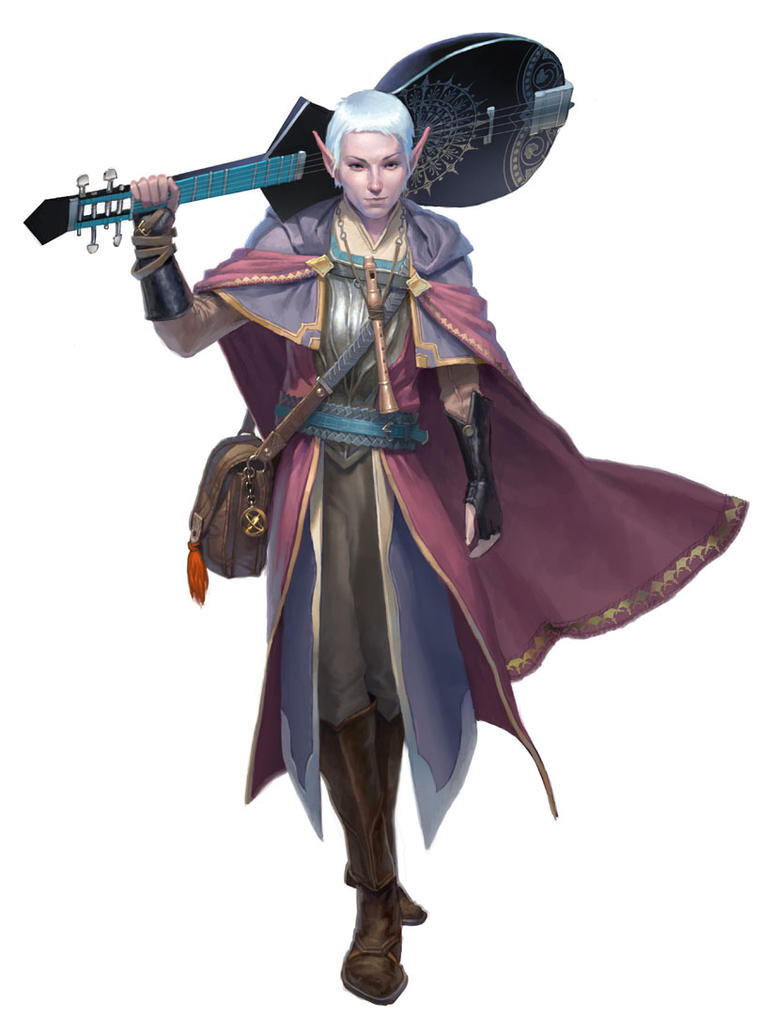
Holy moly! Look at that badass fantasy character! A sweet guitar that sticks out like a sore thumb (in the best way) the subtle wood flute hanging around the neck, the lack of any weapons or aggressive garb. This bard is something unique unto itself. The colors are bright and stylish. Even the character's haircut is edgy and cool. This is a socialite. This is a world-traveler.

And just like the picture, the 5e bard is the king of classes. Highly versatile, interesting, and competent. A skilled magic-user, a healer, and combatant, and even a battlefield inspiration.

It is admittedly a bit overpowered, but at least it's playable in an unironic way.

So what has the ranger done in this same timeframe?

Well, the first ranger I ever saw in a D&D book looked like this:

This is someone I can picture roaming the wilderness for months on end. The armor might be a little overdone, but it also looks rugged and that is important. The weapons are sharp and deadly, there are torches on his back next to his bow, and he is wearing a green, elvish-camouflage cape. He's ready to face the wilds. And he even looks like he has, given his bronzed skin tone (for an elf).

This 3rd edition ranger was not as playable as it seemed, but it was playable nonetheless. Favored Enemy is a very tricky feature to make work in a standard D&D campaign, and that was the main draw of the class. Worst case scenario: your 3E ranger had the high attack bonuses, decent hit points, some fun combat perks to start with, and nice skill points and spells to fill out the weaker areas of the character. If your party needed to track anything, or survive in the wilds, you needed a ranger, no question.

What about the ranger now? Well........


She's either a drow, or a purple elf. Neither of those scream "wanderer of the forests" to me like the tanned elf from before. She is also wearing a bright blue cape and puffy white sleeves. Not exactly camouflage. 

Something tells me that this piece was just supposed to be a warrior-type drow, and when time came to put a ranger picture in the 5e Player's Handbook, somebody grabbed this one, drew a bird onto the bow, and called it a day. Not cool.

And worst of all, the 5e ranger is by-far the least popular class. Only three skills? Someone that survives on their own in the wild with no help only gets three skills from their class? Favored Enemy gets nerfed, even though it was already mediocre at best. And don't even get me started on the current state of the animal companion... what a joke. It's so unpopular, in fact, that WOTC has made it a point to update it completely. Are the updates enough? Eh. I'm on the fence.

The Upswing

So what is wrong with the ranger? Why does it blow nowadays? Why is it "weak"?

Because it doesn't do anything. Sure, it can do all the normal character stuff fine. In fact, it can do all the normal character stuff (moving, hiding, fighting, seeing, hearing, etc.) more reliably than any other class. Move through brambles unhindered, fight invisible things, not lose its way in the woods, etc.

But those things aren't exciting. If a rogue could only hide, and not sneak attack, it would suck (by modern standards). Well, the ranger is exactly that. Sure, he or she can run through a field of pricker bushes without getting slowed down or hurt, but once on the other side of the field, they will put you to sleep with their lack of unique proactive choices.

Doing things was the focus of my Ranger Class without Math from a few months back. If you don't wanna read that through, here is the lowdown.

I give them two major weapon choices in combat: bows and knives. They get to choose whether to engage from afar or close up in each fight, not as a one-time character feature. No more melee OR ranged rangers. Each ranger is both.

I give them an awesome and totally independent animal companion to control, which is just one more sweet and proactive choice they get to make each turn. Every ranger gets one.

I give them the ability to make natural traps, and search for natural traps. Boom. Interesting choices in non-combat time other than tracking.

I give them herbalism and bush medicine to make them healers because if rangers don't know that isht then they die all alone in the woods. Just makes sense, and is uber useful for the party.

See how easy that is? But just like the bard became more capable and proactive between 3rd and 5th editions, the ranger fell from grace. How ironic that the tracker and wayfinder class has lost its way.

But hey, now you know how to fix it.

Saturday, August 27, 2016

That Bard's Got SOUL!

Boy, it's been a long time since I posted. Better put some super useful and groundbreaking content on here to make up for that.

Fact: I'm tired of lutes and panpipes being the tavern background music. So, here we go:
___________________________________________________________

Soulful Bard's playlist - Roll them d20s and hit play!

Note: Songs have no lyrics mentioning post-medieval technology.


1. You Were Never Mine (Cover) - Janiva Magness


2. The Midnight Hour - Wilson Pickett


3. In the Still of the Night - The Five Satins


4. Try a Little Tenderness - Otis Redding


5. Don't Leave Me This Way - Thelma Houston


6. California Dreamin' (Instrumental) - Baby Huey [TURN YOUR VOLUME DOWN]


7. Moanin' - Charles Mingus


8. I Hear the Angels Singing - Eric Bibb


9. Sherry Baby - Frankie Valli & The Four Seasons [Note: Mentions "twist party"]


10. Unchained Melody - The Righteous Brothers


11. This Magic Moment - Ben E King and The Drifters


12. Can't Take My Eyes Off of You - Frankie Valli


13. What's Love Got to Do With It? - Tina Turner


14. Runaround Sue - Dion


15. Duke of Earl - Gene Chandler [Note: this one is particularly appropriate for medieval settings.]


16. The Great Pretender - The Platters


17. Chain Gang - Sam Cooke


18. Natural Woman - Aretha Franklin


19. When a Man Loves a Woman - Percy Sledge


20. I Wish It Would Rain - The Temptations

Saturday, July 16, 2016

5 Goals Your NPC Organizations Shouldn't Have

There are three types of NPC groups in fantasy RPG worlds:
  1. Groups the PCs can fight. Example: the cult of an evil demon lord.
  2. Groups the PCs can receive service from. Example: a merchant guild.
  3. Groups the PCs can join. Example: giant-slayer mercenaries. 

No DM has trouble with the first group. They are the easiest to think-up and use in the game.

The second group is easier than the first, in that their motivations need not be world-shaking or nuanced. They can just be a trading band, after all. But they are also more difficult than the first group, because it is much less natural to roleplay a merchant than an evil cultist, considering how scant merchants are in most fantasy novels and D&D plot-lines. It's very similar to writing: the mundane stuff is the hardest to make believable because you haven't ever given much though to it.

Where many D&D worlds fail, however, is with the third group. I'll give you some examples.

Black-Flame Zealots: If these aren't the coolest divine group ever, I don't know what is. They are Assassin's Creed meets ninja meets Nepalese holy-warrior. If there was a novel or video game about these guys, I'd buy it in a heartbeat. Unfortunately, they are a clandestine order of monks who work primarily out of city hideouts and only battle with the enemies of their god. They are like a thieves guild, but with more smiting and less casual sex.

How in the world do you DM a PC that is a member of this group? How do you convince the PC that going off to a random dungeon and looking for treasure is a reasonable quest given his profession? If an old lady says she has ROUSs in her basement, why on earth would a member of the BFZs offer to help her? Don't they have a dark god to keep at bay?

How about the Cavaliers? Mounted soldiers? Really? That's the kind of character you are going to play in this dungeon-crawling game? One who needs a horse at all times to have any fun?

The deeper you dig into all these supplemental classes and groups, the more you realize that over half of them cannot be played.

Sure, you can take the Purple Dragon Knight prestige class from 3.5's Complete Warrior, but take a look at their description, and the paragraph-long disclaimer about player-character members...

D&D 3.5, Complete Warrior, p. 70, Wizards of the Coast

In the end, a PC Purple Dragon Knight has no rank, no authority, no experience, no service record, no commitment to future service, nothing. They have nothing but an honorary title and a slew of class abilities that seemingly appear out of nowhere, given how little the PC actually has contact with their affiliate group...

These disclaimers are included because the designers know that players want the cool features and titles, but none of the responsibility. The PCs still plan to explore and search for treasure and kill monsters as their primary lifestyle, so being a full-time (or even reserve) member of some army is not on their to-do list.

And why should it be? This is Dungeons & Dragons, not Soldiers & Sergeants. If you want to play a medieval warfare simulator, play one. D&D is not that.

This is a reality that DMs and PCs need to accept: limit yourself so you can focus your game and do it well. Players don't need access to infinite character concepts to have fun, they need access to a handful of character concepts that fit the world and the tone the game is going for. DMs don't need infinite NPC groups from every walk of life, they need a couple dozen groups, the majority of which should be adventuring groups that PCs could easily join while still maintaining their normal day job.

There are a million reasons why an NPC group would be invested in dungeon-crawling and monster-slaying. I'll put a bunch into a blog post sometime. But until then, here are five goals your joinable NPC groups shouldn't have, because they create direct contradictions with the adventuring lifestyle:


1. Operate in a particular area, e.g. a specific city, forest, or even country.

If the PCs ever want to leave, either the PC members have to quit, get some sort of negotiated leave time, or create a convoluted reason for why it is relevant to the Elvish Defenders of Leafwood that Joe the Ranger go off into a desert and dig up some magic scrolls about turning lead into gold.... These groups are type one or type two: enemies or service providers.

2. Research a particular thing unrelated to dungeons, e.g. feywild specialists, divination experts, very specific monster-hunters, etc.

This shouldn't be confused with something like a weapon-specialist group. I'm talking about any group where actively adventuring would cut into their study time, rather than be study time. Sword masters-in-training can hone their skills anywhere, but students of Fey lore have nothing to learn while infiltrating the underground city of the Derro. These kind of academic groups are also type two.

3. Serve a particular (non-deity) leader or country, e.g. a king or empire.

Unless he is the king of dungeon exploration, I don't want to hear about any PCs being in the kingsguard.... These are type one and/or two.

4. Pursue sedentary or mundane professions, e.g. blacksmiting, fishing, etc.

You don't have time to smith while you are slaying dragons and stealing their treasure, so smiths don't do that stuff. They stay home and smith. If you are a smith, you aren't a PC. If you are a PC, you aren't a smith. No ifs, ands, or buts. Type two again.

5. Enact a modern moral or ethical sensibility.

I'm not saying every group should be made up of assholes, but if your PCs come across the Loving Sisters of Peaceful Coexistence, do NOT let them join. Peace and non-violence are for farmers, not adventurers. Sad but true. The players can agree with their message in spirit, but they have to realize that their entire lifestyle (i.e. the entire game) is premised on violence and stealing, whether it is against other sentient races, monstrous races, or just plain ol' monsters. Evil in D&D is real, and it is out to get you. Monsters exist, and they don't only attack when threatened by oil spills or aggressive human expansion. And since the monsters are evil, might as well take their stuff when their dead. Right? Peace can be an ideal in your world, but it cannot be the mainstream. This could be type one or two.

Now go make some NPC groups that love spelunking and looting. I'd join that shit...

Thursday, June 30, 2016

How to Escape the Railroad D&D Game: Get off at a station

Quick announcement: Haven't posted in a while (got a full-time job), but plan to keep posting as often as possible. Will most likely shift my focus from game system design to adventure design, as that is where my head is right now.
____________________________________________________________

"Some players, Mr. DM, just want to watch the world burn." 
 - Someone afraid of sandbox games

"Players don't panic when things go according to plan. Even if the plan is horrifying."
- Someone afraid of railroad games
____________________________________________________________

Oh that unanswerable question: railroad, or sandbox? So short, and so mystifying. Within its seemingly binary choice are paradoxes and contradictions enough to fill entire college courses. See: Free Will vs. Determinism.

But let's boil the idea down to this: every DM wants their players to feel as though they are making choices that impact the world, but how do you do that without needing to literally create an entire world spontaneously?

Some will argue that you make a little "sandbox" and let the players do whatever they want in that little area. Easy. My response is this: even generating a tiny area that is a "free-roam" zone for the players is an unimaginably huge task. The idea doesn't ever scale down. PCs can cover a lot of ground in one session. You can't pre-generate all those possible paths, even in a very limited sandbox. And if you're thinking, "you don't generate everything the PCs can do, just the things they are likely to do" I say, welcome to a railroad game....

Meanwhile, if your argument is that you create some basic details and improvise the rest, you've entered into a similar paradox. If you magically incorporate your details into any path the PCs take, then you are running something VERY close to a railroad game. Best described as the "Quantum Ogre" effect. On the other hand, if you are willing to entirely abandon what you have prepared for the sake of maintaining player agency, then why prep at all? What are the odds that your players will choose exactly what you have prepared for them without railroading them at all?

To further confuse things: For every player that will purposefully avoid a pre-built story for something they think will be more exciting, there is a player who will do the opposite: ignore any hook or moment of inspired DM roleplaying for the never-ending slog through what they see as the "story."

The only way to appease both of these player types is to give the entire decision process over to the players, and then hold them to their choices. Your game must have cause and effect relationships, or the "watch the world burn" types will have no boundaries. Just so, the game needs to have very regular moments of choice, or the "go with the plan no matter what" types will quash everyone's creativity.

Okay, enough theory. Let's talk about putting this into practice.

Step 1: Prepare shit. There are no two-ways around it. You have to prepare sessions if you are going to give them any substance. Dynamic combats with interesting monsters, unique NPCs with believable spots in your world, competent antagonists, and many other parts of great D&D only thrive in the pre-game creative process. Maybe your random tables, acting, and improv are so good you don't really need to prep. If that's the case, I hate you.

Step 2: Accept that session 1 is railroad-y. Every D&D party has to suspend disbelief for long enough to accept that they are together, that they are at least allies in some respect, and that they will continue to work together until further notice. This is not an easy narrative step when your players are supposed to be brimming with "free will" and "agency." As the DM, you have to put your foot down and tell the PCs, "Welcome to session 1. Your characters are are all gathered in ______ for _______ and are planning to do _________. Go." Get the game going, regardless of whether every player is 100% into the mini-plot you have for the first session.

Step 3: Everything in the world has space for a hook. You have to bake hooks right into the body of your game world. Every corner should conceal another hook. But you need to expand your definition of what a hook is. Magic items are hooks. (What is it? Who can tell us? Where are they?) Information is a hook. Overheard conversations. Letters. Gossip. Everything. (The baron's raising an army? Why? Where? Someone mentioned the God of Socks. Who is that? Where can we learn about such a deity?) People are hooks. The dark spells cultists use are hooks. Statues are hooks. Paintings are hooks. EVERYTHING CAN BE A HOOK. Write a sentence for each good one you think up, and remind your players that these hidden treasures of adventure are everywhere if they pay attention and ask questions.

Step 4: Pace your sessions correctly. This will end up being a whole other blog post, but the short version is this: be smart about how long to spend on things around the table, and when to initiate them. Big combat after 4 hours of roleplaying session? Probably a poor idea, especially if it's getting late. Remember: you can always stretch things out with good roleplaying and description. You cannot, however, speed things up arbitrarily. When players focus on something, the time management is under their control. Prepare enough content to fill 50-75% of your session, then stretch it as needed.

Step 5: Finish your sessions at a choice, and have the players make it before ending. This makes #4 doubly important, because step 5 depends of successfully executing step 4. Each session should contain minimal "choice" points at the beginning and middle, because the more your players can veer off the path mid-session, the harder it is to make that session tight and satisfying. BUT, a major choice about what to do next that is placed at the end of a session allow players to tell you exactly what to prepare for next time. This choice point doesn't have to be "multiple choice" either. It can be "open response." So long as you have a week to prep what the PCs choose to do, they can do anything they want. Now THAT is agency.

Hooks are not choice points unless the players have nothing more urgent to do. Hooks can be kept in the back pocket of the party until some adventure time is freed up. This maximizes player agency, because it allows the players to choose the next part of their story organically, based on what most interests them about your game world. Free yourself from the trap of the escalating railroad campaign! You are better than that!

But let's be real: at the end of the day, even this style looks like a railroad. Pre-planned sessions that the PCs can't really change much once they are prepped by the DM.

But railroads can take you anywhere. Railroads (in the sense of pre-prepared sessions and stories) only become constricting when the players get an urge to jump off mid-way between stations. Solution: put in more stations. One at the end of every session. Keep the sessions focused and let them flourish into more depth instead of more plot if you have extra time in the moment. Your players will naturally want to follow mini-stories and plots to their immediate ends. Keeping players focused on a plot for one session is not an impossible task. 

Trying to milk that one major player choice for three or four sessions of material is asking for trouble.